Showing posts with label magic. Show all posts

Sunday, 21 July 2013

The secret life of everyday things


"Almost all absurdity of conduct arises from the imitation of those who we cannot resemble."
(Samuel Johnson)
 

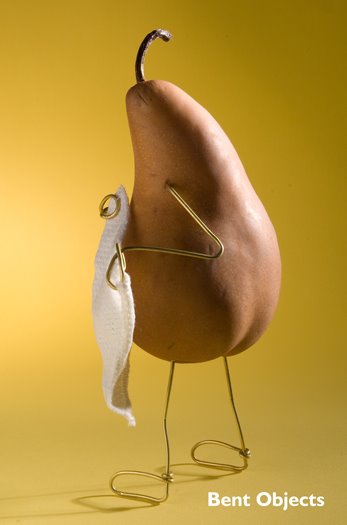
I've often been told I've a "wacky" or absurd sense of humour, inherited from Dad I suppose; I also find very basic, probably puerile, things quite funny. Terry Border is an American photographer and humourist who started creating ridiculous scenes with fruit, veg and household objects about six years ago. Using wire to manipulate and pose his apples, cornflakes and muffins in and out of context, his "Bent Objects" never fail to amuse me.
Terry Border subtitles his art "The secret life of everyday things", which I particularly love. My favourites are the cookie-crumbled who's down and out outside Tiffany's, the candle burning itself at both ends, the enthusiastic (hot)dog who's messed on the newspaper.
There's incongruity and the ridiculous all round us in this world. Just as I look back at photos of my PVC, pacifist-vegetarian-punk trousers and day-glow micro-mini skirts, future generations with an evolved sophistication will refer back to our hopes, fears and ways of being. In fact, there's an innate sophistication and satire in Terry Border's observations. Perhaps my PVC jeans were really sartorial satire; maybe that's why they were so uncomfortable...
Imagination is so frequently dismissed as day-dreaming, yet it produces little sculptures of wit and wisdom such as the creations here. Four hundred years before Christ was born, still centuries before Leonardo Da Vinci was doodling helicopters in his spare time, the Ancient Greek philosopher Archytas was creating bird-shaped, self-propelled flying devices. Once you start to view what seems unlikely or impossible as magical or miraculous, you can see the world as the bright and endlessly benign haven it was intended to be.
"King of Wishful Thinking" is an old favourite sing-along of mine from another of my most loved films. Like my lovely friend Ellen, I know whole swathes of dialogue from the film "Pretty Woman"; actually I probably know all of it, for all the characters. Other friends dismiss it as an unsophisticated 90's "rom-com". Apart from being gently witty and affectionately acted by the leads, it has it's own message. It's Cinderella with a sharp twist: Prince Charming, who sometimes isn't that Charming because he is Sad, meets Cinderella, who has a Hidden Heart of Gold which must stay hidden because Cinders is a Hooker (not the rugby type). Essentially, the Hooker knows more about truth and values than the Prince; he thinks he's saving her but it could just be the other way round. Of course, they live happily ever after, which is totally absurd huh?
I've included the song here mainly for Ellen, but also because after sniffling and smiling my way through the film yet again, I've been singing it for days. I usually only sing in the shower: I thought of joining a choir but they wouldn't all fit in my bathroom.


"On almost any street corner the feeling of absurdity can strike any man in the face."
Albert Camus


terryborder.com


"King of Wishful Thinking"  Go West


"Kiwi getting ready for the Beach" (Terry Border)


Friday, 28 June 2013

The man and the supermoon

"Everyone is a moon, and has a darker side which he never shows to anybody." 
(Mark Twain)


"Man and the Moon", by Tina Palmer


"Moon River" 
(Johnny Mercer) 
Moon river wider than a mile,
I'm crossing you in style someday. 
You dream-maker, you heart-breaker, 
Wherever you're going I'm going your way. 
Two drifters off to see the world; 
There's such a lot of world to see. 
We're after the same rainbow's end, 
Waiting round the bend: 
My huckleberry friend, 
Moon river and me.

"Moon River" Audrey Hepburn ("Breakfast at Tiffany's")

Having finished work very late at the beginning of the week, I wandered off down the High Street in the wee hours, looking for the moon. It seems there are a lot of folk meandering up and down the Lewes Road at 1.30 in the morning, searching for the moon and other things. The moon, perhaps sensibly, was hiding behind a blanket of mist. From my own little street, this larger and brighter than usual moon was barely evident. I live in a low part of Brighton - probably in more ways than one - with steep banks of housing and buildings on either side. A full perigee moon always appears much lower on the horizon: it took three days until the June "supermoon" was on the wane before I could get a photo of it actually over the rooftops in my road.
Some stunning photos from across the world have been taken of the supermoon. I've posted some of them here; the last two are from Brighton; the final and by far the least impressive one is from my doorstep. I was determined to capture a bit of the supermoon: coinciding with the summer solstice and the full moon of St John's night, it seemed like a hopeful beacon. When I was little, my Dad of course told me there was a man in the moon who would know if I wasn't sleeping. Years later, I learned that The Man in the Moon is actually a traditional phenomenon as well as being a sentimental childhood essential.
I hadn't realised that for centuries across the northern hemisphere, the dark areas of the moon, the seas, in contrast to the lighter highlands have been perceived as human features. Maybe we need the moon to show a friendly face: earth's closest neighbour in space, it's comparatively large for a natural satellite orbiting a planet of this size. The moon is the brightest sight in our heavens after the sun, although in fact it's surface is dark, like coal and with a similar reflectance.
Old European tradition tells of a man being banished to the moon for some misdemeanor: Christian folklore depicts him as the man caught gathering sticks for firewood on the sabbath. Another Christian legend depicts him as Cain, doomed to circle the earth in exile, as depicted in Dante's "Inferno". In Norse mythology, the moon was a man in a horse drawn carriage, passing across the sky to escape a great wolf; in the Germanic and Roman cultures, he was also a thief of various descriptions, stealing away over the earth before daybreak.
In some eastern cultures, and particularly in Chinese tradition, the inhabitant of the moon was sometimes thought to be a stranded goddess, with only "moon rabbits" for company. Even today, Chinese children are shown how the features of the moon may represent the moon rabbit, rather than a man's face.
A prominent feature in our night skies and with a regularity of phases, the moon has gained a comforting familiarity since ancient times. The moon's orbit and gravity draw the ocean tides and the length of our days. Scientists believe the moon was formed shortly after the earth, from the fallout of debris and matter after we collided with something the size of Mars. The moon remains the only other celestial body that man has set foot on. Since the United States' Apollo 17 mission in 1972, only unmanned crafts have visited the moon, some confirming the discovery of lunar water ice - the moon's surface can't support liquid water. The Outer Space Treaty declares the moon to be free to all nations to explore for peaceful purposes; a sentiment that perhaps isn't honoured here on earth.
The moon has had a huge influence on folklore, language and the arts. Initially pushed into learning to play the piano when I was little, the first piece of "proper" piano music I grew to love was Claude Debussy's "Clair de Lune". As a fan of Mark Twain, I love the imagery of the song "Moon River" with even a "huckleberry friend". The song features in one of my favourite films, "Breakfast at Tiffany's", with Audrey Hepburn at her most adorable: half Irish and half Belgian and a bit kooky; what's not to like? I love the innocence of Hepburn's film version of the song, although Andy William's velvety voice was a perfect match to the poem and the melody. (I'd recommend looking up the film if you're not familiar with it, or have forgotten how magical it is).
The regular and distinct phases of the moon have made it a convenient and fascinating timepiece throughout history. The waxing and waning of the moon formed the basis of many of the most ancient calendars. The lunar cycle is approximately thirty days long and the English word for "month" and it's cognates in other Germanic languages originate from "the moon"; Germanic cultures relied on lunar calendars before any solar one. The oldest depiction of the moon is thought to be a rock carving at Knowth in Ireland, some five thousand years old.
In some ancient cultures, the moon was personified as a deity or supernatural entity. It has a long association with hopefulness and luck but also with emotions, irrationality and even insanity. The word "lunacy" obviously derives from the Latin name for the moon; even Aristotle, who wasn't short on marbles himself, believed the water component of the human brain must be affected by the moon's tidal power. Today, it's understood that the moon's gravity is too slight to affect an individual's brain function. Tales of increased accidents, homicides, suicides and psychiatric admissions at full moon persist but with little or no consistently supportied evidence. Certainly the euphoria and despair ill-met by moonlight on the Lewes Road most nights owe more to the influences and addictions of this world than the orbit of any satellite.
The full moon has always been emotive for me because it is simply beautiful, as distant and mysterious as it is predictable and symmetrical. My mother used to have me make a wish on the full moon, always starting "Dear God"; wishes, prayers all headed in the same direction. She also told me to turn coins over in my pocket at the new moon for prosperity. Walking down the main road in the first hours of the new day, I couldn't see the big moon for clouds and houses, but I did find the baby moon of a ten pence piece twinkling on the damp pavement.
The moon is a benign companion, to children, drunks, dreamers and doers. It's constancy and luminosity assuage childhood nightmares and adult loneliness. The magic of the night is part romance and part uncertainty and moonlight and moon-shadow will paint pictures that the day cannot sustain. As with everything serenely beautiful, it has an inexorable power, enough to pull the oceans from one shore to another. James Joyce spoke of the moon's "inscrutable tranquility". The same moon that appears to keep pace with me on my walks home at night along the Level will be lingering along with lovers by the Seine or guiding a lost backpacker somewhere unpronounceable. Even when we see the moon wane, it's size and shape remain perfectly the same. Every night, the moon is, generally, where we left it, just like our dreams.


"Three things cannot be long hidden: the sun, the moon, and the truth." 
(Buddha)


Starlings across the full moon at Brighton pier...

... and my own less spectacular photo of the this week's supermoon over my street. 


"Clair de Lune" ("Moonlight")  Claude Debussy

"Sometimes weak and wan, sometimes strong and full of light. The moon understands what it means to be human.
Uncertain. Alone. Cratered by imperfections." 
(Tahereh Mafi)


Wednesday, 24 April 2013

"What a piece of work is a man"


"So long as men can breathe, or eyes can see,
So long lives this, and this gives life to thee."
(Will Shakespeare)

Yesterday was of course St George's feast day, but also the birthday of William Shakespeare, playwright and love-poet extraordinaire We can't know for sure that Will was born on 23rd April: he was definitely baptised on 26th April 1564 and the ceremony would traditionally have taken place three or four days after birth. We know that he died on 23rd April 1616, and folklore holds that he died on his birthday, aged just fitly two years.
Will lived a great deal in that half century; he was a prolific writer and had something of a reputation as a philanderer as well. His work was well received and respected in his own lifetime, but it was in the nineteenth century that his popularity rose to lofty heights. His works have now been translated and performed in every major living language across the world and he's generally accepted as the greatest ever English writer. It seems highly fitting that the birthday of the nation's bard should fall on the same day as the feast of the patron saint.
If your only experience of Shakespeare is of cramming unappetising and dry chunks at school, uninspired by a bored supply teacher attempting drama by pitching their nasal drone slightly higher, do give him another go. My fondness for Shakespeare has grown and evolved since any formal English literature studies ended and as my adult life has unfolded. Amid any speculation about Will's personal life, his sexuality and promiscuity, his political leanings and religious beliefs (his mother, Mary Arden, was certainly a devout Catholic), there's much more to the excellent wordsmith than initially greets the schoolkid's reluctant eye.
Themes of passion and sensuality, loyalty and guilt, ambition and mercy, prejudice and reconciliation all shout, whisper or sing through his works. His wisdom is apparently borne of his own very human foibles; his wit holds the wry humour of one who recognises his foolishness. Aside from the beauty of some of the sonnets, there's a timeless relevance to "Romeo & Juliet", "Othello", "Richard III", "The Merchant of Venice", "Macbeth".... I was twelve years old when I first read "A Midsummer Night's Dream" and it still feels as magical to me today:"Look in the almanac; find out moonshine."

"What a piece of work is a man, how noble in reason, how infinite in faculties, in form and moving how express and admirable, in action how like an angel, in apprehension how like a god."


"No more be grieved at that which thou hast done: 
Roses have thorns, and silver fountains mud." 

"Mine eye and heart are at a mortal war,
How to divide the conquest of thy sight." 

"He jests at scars, that never felt a wound." 

"What is your substance, whereof are you made, 

That millions of strange shadows on you tend?" 

"Some glory in their birth, some in their skill, 
Some in their wealth, some in their body's force,
Some in their garments though new-fangled ill; 
Some in their hawks and hounds, some in their horse." 

"Thy love is better than high birth to me." 

"All the world's a stage, 
And all the men and women merely players; 
They have their exits and their entrances; 
And one man in his time plays many parts." 

"The course of true love never did run smooth.” 

"Stars, hide your fires; Let not light see my black and deep desires." 

"By the pricking of my thumbs, something wicked this way comes." 

"Expectation is the root of all heartache." 

"Love is not love 
Which alters when it alteration finds, 
Or bends with the remover to remove." 

"Nothing is so common as the desire to be remarkable." 

"Sit by my side, and let the world slip: we shall ne'er be younger." 

"Tis an ill cook that cannot lick his own fingers." 

"If there is a good will, there is great way." 

"There's a divinity that shapes our ends, 
Rough-hew them how we will." 

"No sooner met but they looked; 
No sooner looked but they loved; 
No sooner loved but they sighed; 
No sooner sighed but they asked one another the reason; 
No sooner knew the reason but they sought the remedy; 
And in these degrees have they made a pair of stairs to marriage." 

"The quality of mercy is not strain'd, 
It droppeth as the gentle rain from heaven 
Upon the place beneath: it is twice blest; 
It blesseth him that gives and him that takes." 

"There is a tide in the affairs of men 
Which, taken at the flood, 
Leads on to fortune 
ommitted; 
All the voyage of their lives
Are bound in shallows and in miseries." 

"How far that little candle throws his beams! 
So shines a good deed in a weary world." 

"Not from the stars do I my judgement pluck; 
And yet methinks I have Astronomy." 

"It is not in the stars to hold our destiny but in ourselves." 

"God has given you one face, and you make yourself another." 

"Cowards die many times before their deaths; 
The valiant never taste of death but once." 

"Better three hours too soon than a minute too late."

"But Oh, how bitter a thing it is to look into happiness through another man's eyes." 

"We know what we are, but know not what we may be." 

"Give every man thy ear, but few thy voice." 

"One touch of nature makes the whole world kin." 

"I wasted time, and now doth time waste me." 

"My crown is called content, a crown that seldom kings enjoy." 

"Heat not a furnace for your foe so hot that it do singe yourself." 

"Fortune brings in some boats that are not steered." 

"Neither a borrower nor a lender be." 

"I would challenge you to a battle of wits, but I see you are unarmed." 

"This above all; to thine own self be true." 


"Who will believe my verse in time to come, 
If it were filled with your most high deserts?"


"Everyday I Write the Book" Elvis Costello (acoustic)


"No legacy is so rich as honesty." 
(Will Shakespeare)