Showing posts with label belief. Show all posts

Sunday, 4 January 2015

It's a Cracker: in search of Comfort and Joy


"Ring out the old, ring in the new;
Ring, happy bells, across the snow.
The year is going, let him go;
Ring out the false, ring in the true."
(Alfred Tennyson)
 
 I had already prepared this and another fairly light-hearted post for the New Year before events beyond Gigionsea shocked and saddened the world. Planes drop from the heavens and people continue to take up arms against each other; disease and discontent find seemingly endless ways to hide and thrive and re-invent in the dark recesses of fear and deprivation. The news through the yuletide period into the New Year has been bleak. I held onto my posts like leftover crackers, not wanting to be trite or uncaring.
Yet the truth of it is that terrible things really do happen everyday to good, ordinary people. There really are ''natural disasters''; the progression of technology is ultimately powerless against the might of the elements or the repeated lessons of human failing. If we have evolved as a species with our Googling of the best ''friendly bacteria'', we must accept that the tiniest, most insignificant-seeming microbe might grow and mutate and find alien ways to attack us.
Through it all, life remains essentially an unbidden gift and . Although I have my own boundaries, incidents and situations I would never make light of or joke about, I also respect the resilience of the smile. As I unashamedly believe in God, I believe that we can find the laughter of God everywhere; as often as we can invoke His tears.
We will all die: this is a certainty but no less distressing and even painful for that. Some of us will die young, some old. Some of us will die in planes, on the road, at the hands of another, in an anodyne hospital bed. The truest tragedy is not to have lived up to that moment; not to have said that ''hello'' as much as any goodbye. Not to have made that call, seen that sunset, painted that picture, held that person. Each time we witness the inevitability of our mortality or the indiscriminate lottery of fortune, surely we must find life all the more precious? Death is indeed inevitable but the giving and living of life are unconditionally wondrous, whatever church you will or won't subscribe along the way.
Many of the traditional excesses that found their way onto our Christmas dinner tables or hung around our bedraggled front rooms on New Year's Eve are rooted in the debauched and often cruel carnival that the Romans celebrated at Saturnalia. Depending on your viewpoint, Saturn was the resident god of seeds and harvest, liberation and wealth, waging war and death, Saturn's festival would run in the Julian calendar from around 17th December for more than a week. Animal and even human life was sacrificed, fires were lit, huge feasts consumed, lavish gifts and displays of affection and lust were exchanged. Within the continual partying, drunkenness, extravagant costumes, ribald humour and wild sex were to be expected. It was probably not unlike Brighton's West Street at dusk in the run-up to Christmas Eve.
At it's most innocuous, Saturnalia was also a festival of lights leading up to the winter solstice, with an abundance of candles lighting the quest for knowledge and truth. The advent of the new year was celebrated in the later Roman empire with the feast of the "Sol Invictus"; the Unconquerable Sun...
Our baubled Christmas trees and bumbled kisses under the mistletoe are steeped in Roman pagan beliefs. My own tree, Noel, now in his ninth year, is currently flickering outside my back door. His outdoor lights may be from B & Q, but his triangular shape and evergreen presence are rooted (sorry) in the conversion of pagan festivity to Christian celebration, with symbolism evolving to illustrate the holy trinity and eternal life.
I wondered where Christmas crackers originated from and was surprised to learn they only surfaced in 1840s Europe. One Tom Smith, a noted purveyor of confectionery, created larger "bon-bons", wrapped with a twist at the end. He inserted little love messages and tokens into the bon-bons; then small gifts, mottos and jokes. He latter added the banger mechanism to emulate the crackle and pop of  yuletide fires and fireworks. The revised name "cracker" is onomatopoeic. The inclusion of paper crowns takes us right back to Romans; even the servants would play at being kings for a few days.
Finding absurdity and joy in the nitty-gritty minutiae and harshest realities of life truly is as ancient as looking to the stars for miracles.
 
"Semper Saturnalia agunt. (They're always celebrating Saturnalia.)"
(Petronius)
 
"Non semper Saturnalia erunt. (It won't always be Saturnalia-time.)"
(Seneca)


"In Dulce Jubilo"  Mike Oldfield
 
 
(Photo: Gigi, album)
Noel the Christmas Tree; Comfort and Joy, from my home to yours x
 

Sunday, 21 July 2013

The secret life of everyday things


"Almost all absurdity of conduct arises from the imitation of those who we cannot resemble."
(Samuel Johnson)
 

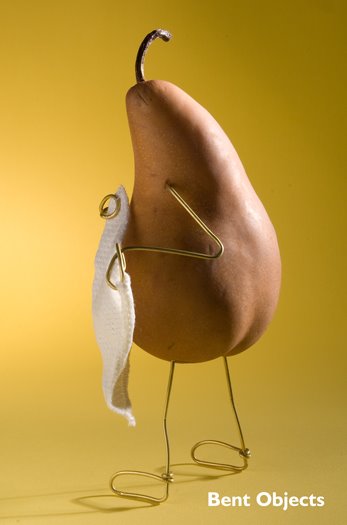
I've often been told I've a "wacky" or absurd sense of humour, inherited from Dad I suppose; I also find very basic, probably puerile, things quite funny. Terry Border is an American photographer and humourist who started creating ridiculous scenes with fruit, veg and household objects about six years ago. Using wire to manipulate and pose his apples, cornflakes and muffins in and out of context, his "Bent Objects" never fail to amuse me.
Terry Border subtitles his art "The secret life of everyday things", which I particularly love. My favourites are the cookie-crumbled who's down and out outside Tiffany's, the candle burning itself at both ends, the enthusiastic (hot)dog who's messed on the newspaper.
There's incongruity and the ridiculous all round us in this world. Just as I look back at photos of my PVC, pacifist-vegetarian-punk trousers and day-glow micro-mini skirts, future generations with an evolved sophistication will refer back to our hopes, fears and ways of being. In fact, there's an innate sophistication and satire in Terry Border's observations. Perhaps my PVC jeans were really sartorial satire; maybe that's why they were so uncomfortable...
Imagination is so frequently dismissed as day-dreaming, yet it produces little sculptures of wit and wisdom such as the creations here. Four hundred years before Christ was born, still centuries before Leonardo Da Vinci was doodling helicopters in his spare time, the Ancient Greek philosopher Archytas was creating bird-shaped, self-propelled flying devices. Once you start to view what seems unlikely or impossible as magical or miraculous, you can see the world as the bright and endlessly benign haven it was intended to be.
"King of Wishful Thinking" is an old favourite sing-along of mine from another of my most loved films. Like my lovely friend Ellen, I know whole swathes of dialogue from the film "Pretty Woman"; actually I probably know all of it, for all the characters. Other friends dismiss it as an unsophisticated 90's "rom-com". Apart from being gently witty and affectionately acted by the leads, it has it's own message. It's Cinderella with a sharp twist: Prince Charming, who sometimes isn't that Charming because he is Sad, meets Cinderella, who has a Hidden Heart of Gold which must stay hidden because Cinders is a Hooker (not the rugby type). Essentially, the Hooker knows more about truth and values than the Prince; he thinks he's saving her but it could just be the other way round. Of course, they live happily ever after, which is totally absurd huh?
I've included the song here mainly for Ellen, but also because after sniffling and smiling my way through the film yet again, I've been singing it for days. I usually only sing in the shower: I thought of joining a choir but they wouldn't all fit in my bathroom.


"On almost any street corner the feeling of absurdity can strike any man in the face."
Albert Camus


terryborder.com


"King of Wishful Thinking"  Go West


"Kiwi getting ready for the Beach" (Terry Border)


Friday, 19 July 2013

Keep the earth below my feet


"The true object of all human life is play. Earth is a task garden; heaven is a playground."
(G.K. Chesterton)


Due to my technical difficulties in recent weeks, I've had thoughts for a particular post flapping around in my full little head since the feasts of the Ascension and Pentecost. I started thinking about our notions of heaven and earth and what store we might set by any separation or unity of the two.
The ascension of Jesus to heaven has always provided atheists and sceptics with massive heartburn. Bible critics point to the mythical cosmology of the New Testament in particular, citing the structural convenience of heaven above, earth as the middle ground and the depths of the underworld below; furthest removed from the celestial realm. Sceptics have also suggested that accounts of Jesus' ascension tidily discredited any possible ongoing claims of Jesus appearing within the growing Christian community. Yet the tradition of Jesus' ascension, professed in both the Apostles' and Nicene Creeds, is certainly accepted and respected across the Catholic, Orthodox and Protestant churches. The bodily ascension is seen as an obvious and unequivocal sign of Jesus' humanity and divinity, of his participation in our story and God's
power and love.
Jesus refers to heaven and the Father there throughout his ministry, accepting his inevitable return and promising us the same rise. Sounds a bit too pie in the sky to be feasible? We wordy humans refer to heaven constantly as we respond to both the minutiae and more unusual stresses or pleasant surprises in our daily lives. It's very, very hot in Brighton at the moment, but far from drawing comparisons with any fiery pit down below (and I don't mean the Antipodes), Brightonians and tourists alike exclaim that this is "heavenly weather", "heaven on earth". My neighbour described her leafy back garden as "paradise" earlier.
 It seems most of us grow up with the notion that there is a heaven "up there": somewhere over the rainbow; even higher than the sky, beyond the sun, in another dimension; infinity and beyond. We can calculate and probe the centre of our earth; we can salvage from the ocean floor. We know how to make fire and usually how to put out flames. Yet no rocket can ever really touch the sky. "To infinity and beyond" may conjure up ethereal realms but nitty gritties such as maths and physics are always in the elusive mix. We can hazard a guess at what the Neanderthals preferred for midweek dinner, but we can't quite calculate the edges of the universe; where our world might end and another could begin.
I like the Pentecostal symbolism of Spirit enfolding air, water and fire: the rushing wind that heralds Spirit, the water of baptism and the tongues of flame that anoint and inspire the Apostles. I understand now that the fourth element, earth, is found in the Apostles themselves. Man is grounded and of earth itself. And it's essentially a wonderful place, unimagined and still misunderstood by us, for all our scientific and philosophical digging. Whether you subscribe to the Big Bang Theory, the Bigger Big Bang Theory, or believe in creation by a higher power, we did not make this earth which supports our vast ambitions alongside the most microscopic, ancient ecosystems. Of course there are inherent extremes of temperature and terrain across this planet, but so many of the world's crisis and problems are due to man's mismanagement and lack of safe-guarding.
People starve, not because of some vaguely discriminating natural law or the survival of the fittest. A huge proportion of the finest arable land is used to grow grain to feed an increased animal population to satisfy meat consumerism. In the United States alone, 175 million tons of cereals and vegetable protein, suitable for human consumption, is fed to livestock bound for just 28 million tons of animal protein, often in the form of "fast food".
I assure you this is not a vegetarian rant. In what we constantly refer to as developing countries, the use of land to create and maintain an artificial food chain has resulted in misery and famine for millions of our neighbours. One acre of land used for local cereal or vegetable production will respectively produce five and ten times more protein than one acre used for meat production for market elsewhere. In the case of crops such as soya, the probable increased protein yield is thirty times more.
The terrible human consequences of the shift of focus from food to feed were dramatically evident during the Ethiopian famine in 1984. Ethiopians starved in front of our TV cameras, but Ethiopia was harvesting a wealth of linseed and rapeseed for European livestock. We wept as the redoubtable Michael Buerk reported on famine and desolation on an epic, biblical scale. The region held by many to be the location of the Garden of Eden was described as "hell on earth".
Ordinary people responded with what was seen to be extraordinary kindness. A dishevelled potty-mouthed Oirish punk called Bob shouted, swore and sweated and celebrities suddenly found their own feet of clay could actually help kick political butts. The BBC and CBC footage from 1984 still makes me cry: as it did for so many other people, "Live Aid" changed me and the way I saw the world, man and God. I remember the concerts as though they were last week, not thirty years ago. Unfortunately, the famine in that region and others has proved endless. Charity surged and continues to flow but common sense and economic justice still don't amount to much for governments and the corporate world.
It's both a tragedy and a travesty that 80 percent of the earth's hungry children live in lands with food surpluses which are fed to animals bred for consumption by the affluent. It's a terrible irony that tens of thousands in the so-called First World die every year from diseases exacerbated by affluence: heart disease, strokes, diabetes and some cancers. Many years ago, a lovely old man in a loincloth and blanket pointed out that the earth has enough to sustain man's needs but not his greed; we nodded at Gandhi's wisdom and smiled at his naiveté.
On this glowing, fine day, I truly don't wish to put anyone off their barbecued beef or even their bean burger. Yet under the same unremitting blue sky, military experts warn today that Britain must "be prepared to go to war" in Syria to effectively end the conflict there and keep chemical weapons out of terrorist hands. The United Nations has already called the conflict in Syria the worst humanitarian conflict of the past twenty years, estimating 100,000 fatalities so far. Millions of Syrians have already fled or been displaced and hunger and disease breed in their tracks.
Man should never be prepared to go to war: it's a chillingly pointless statement when you strip away ideologies and strategies, flags and uniforms. We tend our gardens and man our borders for personal preservation. The ancient indigenous populations knew that we belong to the earth rather than vice versa; we are indeed borrowing it for and from our children. Herbaceous borders are lovely but boundaries and division confine as well as protect. It riles me particularly when people say:"You guys believe in God - why doesn't he stop the war?" God doesn't start war; if all men really believed in God, heaven and hell and themselves, they wouldn't start it either.
It's seen as human nature to seek comfort, provenance and heaven on earth. Walking across the Level here in Brighton, I see folk seeking enlightenment or oneness with the universe through various cultivated substances. The Sanskrit word "nirvana" literally means "blown out", as in a candle, referring to the stillness and peace of mind which remain after desires, dissentions and delusion are extinguished. But you can't drink your way to Spirit, or smoke your way to heaven.
I do believe that we encounter people, places and events that help us on our individual paths to heaven. If we're fortunate, we recognise our soul mates along the way. If we're blessed, our soul mates recognise us back. There's much beauty to be found on earth and much more to aspire to beyond. I believe we should embrace and cherish this world rather than reaching to pull the next down to us, like a fruit-laden branch to be plundered and muddied.
 

"On earth there is no heaven, but there are pieces of it."
(Jules Renard)


"Aim at heaven and you will get earth thrown in."
(C.S. Lewis)
 

"Below My Feet"  Mumford and Sons


"Keep the earth below my feet;
For all my sweat, my blood runs weak.
Let me learn from where I have been;
Keep my eyes to serve, my hands to learn."
(Dwane, Lovett, Mumford, Marshall)


"And forget not that the earth delights to feel your bare feet and the winds long to play with your hair."
(Kahlil Gibran)


Wednesday, 17 July 2013

Great and small


"Three things will last forever--faith, hope, and love--and the greatest of these is love."
(1 Corinthians 13:13)

 
Sometimes, things just fit together in this wee blog; just as sometimes in life, tiny baby steps take us to a place where the bigger picture may suddenly be hugely appreciable. I'm indebted to my gorgeous friend Christine, who I first met when we were mini-kilted convent girls and re-united with on here, for sharing the "Ten Ways to Love" with me. I'm also grateful to my new friend Anthony for sharing the wonderful "drummer" version of "How Great Thou Art", performed by members of the World Outreach Church. I don't know much about WOC, beyond that they're an interdenominational and pastoral ministry, originally based in Tennessee, USA: you can find them at: www.wochurch.org. As a frustrated drummer who hasn't got her bodhran organised yet, I've listened to this version of a much loved hymn over and over until finding the right post for it.
The words and music here seem to compliment each other seamlessly; a real marrying up of the simplicity of little ways of grace and the greatness of being. And in fact, Christine's marriage to Colin and Anthony's with Abby are both inspirational unions: this post is for them.
I've had a couple of friends moan that some of my posts are too long. This may or may not be shorter, but how long is a piece of string before it ceases to be a piece and becomes a length? Similarly, my sister and brother-in-law fret that my blog seems too Catholic; other Catholic friends, who are infinitely more learned about the church then me, feel "it isn't Catholic enough". All I can say is that I try to make this blog as open and honest as possible because that is what I crave from people and from life. Brighton, friends, being Catholic, animals, poetry, flowery frocks, Springsteen and treacle tart all make me happy. I suspect at least some of these things will make some other people happy too; for others, this humble blog will never be enough of one thing or may seem too much of the other.

I'm actually hurting about something right now, critically aware of my own smallness. This blog generally and this post at this particular moment are my own little steps to the bigger picture; if it can soothe somebody else then I also feel blessed by that.
The little steps in the Ten Ways to Love are literally as old as the hills on the Sinai Peninsula. They may appear removed from the grandeur and solemnity of the Ten Commandments, but look again. If we could all truly achieve these Ten Ways to Love, surely we wouldn't need to be reminded not to lie, cheat, steal or harm?
May each sunrise bring you hope and every sunset, peace. May all your little steps bring you into being as great as you can be.


"How Great Thou Art" World Outreach Church
 
"Be faithful in small things because it is in them that your strength lies."
(Mother Teresa)

"Do the difficult things while they are easy and do the great things while they are small. A journey of a thousand miles must begin with a single step."
(Lao Tzu) 

"For small creatures such as we the vastness is bearable only through love."
(Carl Sagan)


"Miracles are a retelling in small letters of the very same story which is written across the whole world in letters too large for some of us to see".
(C.S. Lewis)


"One sees great things from the valley; only small things from the peak."
(G.K. Chesterton)

 
"Every happening, great and small, is a parable whereby God speaks to us, and the art of life is to get the message."
(Malcolm Muggeridge)


Monday, 15 July 2013

A heart-shaped mind

"If you desire to know … ask grace, not instruction"
(St Bonaventure)
 
When I was a convent schoolgirl down in Greenwich, I was vaguely aware of  the affectionately named "St Bon's", a fellow Catholic grammar school over in Forest Gate, east London. Today is the feast day of their patron, the medieval theologian and philosopher who became St Bonaventure, one of the Doctos of the Church.
Giovanni di Fidanza was born in Tuscany in 1221; the name Bonaventure derives from the Italian "Buona ventura", for "good fortune". His legend tells of his mother asking for St Francis' intercession when he was a sickly infant; his cure was seen as a sign of his favour and good fortune. Giovanni would eventually be elected as Minister General of the Franciscan Order at the age of 36 and would be credited with virtually re-founding it.
A contemporary of St Thomas Aquinas at the University of Paris, Giovanni became known for his kind heart and loving disposition as much as for his prowess as a scholar and his own prolific writings. He was an unparalleled teacher, although his own theology was innovative for the times he lived in and still thought provoking today. He spoke of the emptiness of "knowledge without devotion, research without the impulse of wonder, prudence without the ability to surrender to joy". He likened "learning sundered from love, intelligence without humility" to studying without the sustenance of grace. "To know much and taste nothing - of what use is that?" he said.
There are more than thirty men and women revered as Doctors of the Church; St Bonaventure is known as the "Seraphic Doctor"; his teachings emphasised that faith developed not only through knowledge and understanding but mysticism. As a theologist, he sought to totally integrate faith, feeling and reason. His way set the Franciscans on course to become the most prominent order in the Catholic Church until the birth of the Jesuits. Undoubtedly possessed of a mighty intellect himself, he taught that a great mind can't be elevated without the wings of the loving heart. St Bonaventure saw God as the absolute and perfect being, the essence that brings all other composite beings to existence.
In 1274, Pope Gregory X insisted that he sit at the second Council of Lyon. His contributions there were significant and instrumental in uniting the Greek and Latin churches. The Council saw the Orthodox acceptance of the papacy and the adaption of the Nicene Creed. That same year, he died on this day; suddenly and in suspicious circumstances that have led to tales of poisoning. St Bon's is now a thriving comprehensive; still Catholic, it's adapted to the educational needs of the times without compromising it's tradition in faith.


 "In everything, whether it is a thing sensed or a thing known, God Himself is hidden within."
(St Bonaventure) 

 
 "River"  Emeli Sande


Friday, 28 June 2013

The man and the supermoon

"Everyone is a moon, and has a darker side which he never shows to anybody." 
(Mark Twain)


"Man and the Moon", by Tina Palmer


"Moon River" 
(Johnny Mercer) 
Moon river wider than a mile,
I'm crossing you in style someday. 
You dream-maker, you heart-breaker, 
Wherever you're going I'm going your way. 
Two drifters off to see the world; 
There's such a lot of world to see. 
We're after the same rainbow's end, 
Waiting round the bend: 
My huckleberry friend, 
Moon river and me.

"Moon River" Audrey Hepburn ("Breakfast at Tiffany's")

Having finished work very late at the beginning of the week, I wandered off down the High Street in the wee hours, looking for the moon. It seems there are a lot of folk meandering up and down the Lewes Road at 1.30 in the morning, searching for the moon and other things. The moon, perhaps sensibly, was hiding behind a blanket of mist. From my own little street, this larger and brighter than usual moon was barely evident. I live in a low part of Brighton - probably in more ways than one - with steep banks of housing and buildings on either side. A full perigee moon always appears much lower on the horizon: it took three days until the June "supermoon" was on the wane before I could get a photo of it actually over the rooftops in my road.
Some stunning photos from across the world have been taken of the supermoon. I've posted some of them here; the last two are from Brighton; the final and by far the least impressive one is from my doorstep. I was determined to capture a bit of the supermoon: coinciding with the summer solstice and the full moon of St John's night, it seemed like a hopeful beacon. When I was little, my Dad of course told me there was a man in the moon who would know if I wasn't sleeping. Years later, I learned that The Man in the Moon is actually a traditional phenomenon as well as being a sentimental childhood essential.
I hadn't realised that for centuries across the northern hemisphere, the dark areas of the moon, the seas, in contrast to the lighter highlands have been perceived as human features. Maybe we need the moon to show a friendly face: earth's closest neighbour in space, it's comparatively large for a natural satellite orbiting a planet of this size. The moon is the brightest sight in our heavens after the sun, although in fact it's surface is dark, like coal and with a similar reflectance.
Old European tradition tells of a man being banished to the moon for some misdemeanor: Christian folklore depicts him as the man caught gathering sticks for firewood on the sabbath. Another Christian legend depicts him as Cain, doomed to circle the earth in exile, as depicted in Dante's "Inferno". In Norse mythology, the moon was a man in a horse drawn carriage, passing across the sky to escape a great wolf; in the Germanic and Roman cultures, he was also a thief of various descriptions, stealing away over the earth before daybreak.
In some eastern cultures, and particularly in Chinese tradition, the inhabitant of the moon was sometimes thought to be a stranded goddess, with only "moon rabbits" for company. Even today, Chinese children are shown how the features of the moon may represent the moon rabbit, rather than a man's face.
A prominent feature in our night skies and with a regularity of phases, the moon has gained a comforting familiarity since ancient times. The moon's orbit and gravity draw the ocean tides and the length of our days. Scientists believe the moon was formed shortly after the earth, from the fallout of debris and matter after we collided with something the size of Mars. The moon remains the only other celestial body that man has set foot on. Since the United States' Apollo 17 mission in 1972, only unmanned crafts have visited the moon, some confirming the discovery of lunar water ice - the moon's surface can't support liquid water. The Outer Space Treaty declares the moon to be free to all nations to explore for peaceful purposes; a sentiment that perhaps isn't honoured here on earth.
The moon has had a huge influence on folklore, language and the arts. Initially pushed into learning to play the piano when I was little, the first piece of "proper" piano music I grew to love was Claude Debussy's "Clair de Lune". As a fan of Mark Twain, I love the imagery of the song "Moon River" with even a "huckleberry friend". The song features in one of my favourite films, "Breakfast at Tiffany's", with Audrey Hepburn at her most adorable: half Irish and half Belgian and a bit kooky; what's not to like? I love the innocence of Hepburn's film version of the song, although Andy William's velvety voice was a perfect match to the poem and the melody. (I'd recommend looking up the film if you're not familiar with it, or have forgotten how magical it is).
The regular and distinct phases of the moon have made it a convenient and fascinating timepiece throughout history. The waxing and waning of the moon formed the basis of many of the most ancient calendars. The lunar cycle is approximately thirty days long and the English word for "month" and it's cognates in other Germanic languages originate from "the moon"; Germanic cultures relied on lunar calendars before any solar one. The oldest depiction of the moon is thought to be a rock carving at Knowth in Ireland, some five thousand years old.
In some ancient cultures, the moon was personified as a deity or supernatural entity. It has a long association with hopefulness and luck but also with emotions, irrationality and even insanity. The word "lunacy" obviously derives from the Latin name for the moon; even Aristotle, who wasn't short on marbles himself, believed the water component of the human brain must be affected by the moon's tidal power. Today, it's understood that the moon's gravity is too slight to affect an individual's brain function. Tales of increased accidents, homicides, suicides and psychiatric admissions at full moon persist but with little or no consistently supportied evidence. Certainly the euphoria and despair ill-met by moonlight on the Lewes Road most nights owe more to the influences and addictions of this world than the orbit of any satellite.
The full moon has always been emotive for me because it is simply beautiful, as distant and mysterious as it is predictable and symmetrical. My mother used to have me make a wish on the full moon, always starting "Dear God"; wishes, prayers all headed in the same direction. She also told me to turn coins over in my pocket at the new moon for prosperity. Walking down the main road in the first hours of the new day, I couldn't see the big moon for clouds and houses, but I did find the baby moon of a ten pence piece twinkling on the damp pavement.
The moon is a benign companion, to children, drunks, dreamers and doers. It's constancy and luminosity assuage childhood nightmares and adult loneliness. The magic of the night is part romance and part uncertainty and moonlight and moon-shadow will paint pictures that the day cannot sustain. As with everything serenely beautiful, it has an inexorable power, enough to pull the oceans from one shore to another. James Joyce spoke of the moon's "inscrutable tranquility". The same moon that appears to keep pace with me on my walks home at night along the Level will be lingering along with lovers by the Seine or guiding a lost backpacker somewhere unpronounceable. Even when we see the moon wane, it's size and shape remain perfectly the same. Every night, the moon is, generally, where we left it, just like our dreams.


"Three things cannot be long hidden: the sun, the moon, and the truth." 
(Buddha)


Starlings across the full moon at Brighton pier...

... and my own less spectacular photo of the this week's supermoon over my street. 


"Clair de Lune" ("Moonlight")  Claude Debussy

"Sometimes weak and wan, sometimes strong and full of light. The moon understands what it means to be human.
Uncertain. Alone. Cratered by imperfections." 
(Tahereh Mafi)


Saturday, 22 June 2013

"Blessed be"


"You are a child of the universe, no less than the trees and the stars;
you have a right to be here.
And whether or not it is clear to you, no doubt the universe is unfolding as it should.
Therefore be at peace with God, whatever you conceive Him to be,
and whatever your labours and aspirations, in the noisy confusion of life keep peace with your soul.
With all its sham, drudgery and broken dreams, it is still a beautiful world.
Be cheerful. Strive to be happy."
(From "The Desiderata", Max Ehrmann)


Yesterday, 21st June, was the Summer Solstice. A solstice occurs twice a year when earth's semi-axis is most inclined towards the sun, when the sun reaches the highest position in the sky as seen from either of the poles. The summer solstice occurs on the day that has the longest period of sunlight outside of the polar regions, although the solstice itself is effectively an instant in time. The word derives from the Latin for sun-stopping - "solstitium".
The June solstice marks the first day of the summer season in the northern hemisphere. On this day, the sun doesn't rise precisely in the east, but rises north east and sets to north west, enabling it to be in the sky for a longer period of time. In the southern hemisphere, the June solstice is the shortest day of the year, when the sun is furthest from the equator.
The solstice has remained a special moment in the annual cycle of the year since Neolithic times. The solstices and equinoxes were essential to the development and maintenance of calendars. The seasons and weather played a huge role in people's lives, particularly in the cultivation and harvest of crops. Over the centuries, the June solstice has been a time of ritual, celebration and festivities. In parts of Scandinavia and the Baltics, it's the most important holiday time after Christmas and New Year's Eve.
Originally a pagan holiday, in Christianity the mid-summer solstice became associated with the birth of John the Baptist, whose feast occurs on 24th June: the gospels imply that John was born six months before Jesus. The celebration of St John's Eve evolved from the ancient festival of Midsummer's Eve; summer solstice. On this night, people gathered "magical" golden-flowered plants such as Calendula and St John's Wort, still renowned for their healing properties. Bonfires were traditionally lit to guard against evil spirits, and witches were said to be seen gathering or meeting with other mystical beings. In the 7th century, St Eligius warned the newly converted people of Flanders against pagan solstice practices, saying there should be no dancing or leaping on the feast of St John the Baptist.
 

Across Europe there are various locally adapted solstice celebrations around the feast of St John. In Ireland, many towns have midsummer carnivals and in rural areas bonfires are still lit on hilltops for St John's Night. Bonfires are also lit on the high hills of Cornwall. The week-long festival "Golowan" is celebrated in Penzance and runs from the Friday nearest to the feast of St John: the festival was originally called "Gol-jowan", after the saint. Midsummer festivals are celebrated in many parts of Scotland, notable the Scottish Borders. St John's Eve traditionally has a mystical significance and inspired Sir Walter Scott's well known ballad of that name.
No self-respecting neo-pagan would pass on a trip to Stonehenge at summer solstice. My blogger friend Annie was there to see the break of day yesterday, along with 20,000 similarly spirited people. Annie is a lovely girl who says she is a "leaped" rather than lapsed Catholic: she says she's jumped back to the celebrations of nature and Spirit which existed before Christ was born but don't contradict the existence of the Creator or of the Son of God. I have a lot of time for Annie. I've always felt an affinity for Desmond Tutu's very simple vision of "The God who existed before any religion"; who was not concerned that a deeply spiritual man such as Gandhi was not Christian because He was not a Christian. When Annie emailed to say she was going to Stonehenge, I asked her to say a couple of prayers for me at dawn; she said the Our Father, the Hail Mary and the Gloria Patri. Once a Catholic, eh Annie?
Stonehenge is now known to have been a Neolithic burial place some 8,000 years before the birth of Christ. By 3,000 B.C. the henge was a sacred place and also a mighty sundial and celestial calendar. I've only been there once; the stones were already roped off from visitors, but I felt it was a common holy ground. There are further celebrations planned there over the next few days: this June's "supermoon" is seen as auspicious by many. The moon's own orbit of the earth is oval, so at certain points it can come much closer to us. Scientists say that supermoons are the result of coincidence; this solstice weekend, the supermoon will coincide with the full moon on St John's Eve. The moon should be thirty percent bigger and therefore much brighter than usual. The next supermoon will be in August 2014.
When I email Annie, I sometimes end with "Blessed be" instead of the usual "God bless" to good friends. I appreciate it's a combined greeting and farewell used by many pagans, but I comfortably use it as a Catholic. It's primarily a blessing, a wish for goodness; what could be lovelier than that? I see a lot of so-called New Ageism around Brighton, often cultivated in the shadowy place between despair and hopefulness. There are a lot of younger people who seem drawn to the old ways of wicca, almost in rebellion against Christianity and mainstream religion as a rite of passage.
I have no problem with the term "wicca"; in fact, I respect it's origins in the old Saxon and Norse words for wisdom. Wiccans, also giving rise to the name for witches, were originally those who knew about the land, the elements and the stars. The forefathers of herbalists, homeopaths, astronomers, chiropractors, acupuncturists, spiritual healers.... Sageness, intuition and mysticism gave way to suggestions of sorcery. Everything light will have it's dark side if people look for shadows, whether that be to hide in or to expose others.
I tend to mention my Scottish granny Barbara because I often think of her, although I never met her. Her way of knowing things, apparently passed from her own mother, was accepted by Mum although she worried that I'd inherited it. In short, it spooked her, but it's never disturbed me. When I was at convent school, some girls messed around with teenage spells and even ouija boards; the latter in particular horrified me. I'm quite clear that I should never have any truc with them: I don't believe you should ever take it upon yourself to call people, past or present, or material things to you. What your heart knows and your soul recognises are within you by the grace of God. We should protect our own wisdom and instinctive knowledge; I appreciate faith as the deepest intuitive feeling a person may have.
The solstice marked a double-whammy of firsts in Brighton. English Heritage unveiled a Blue Plaque yesterday at Tyson Place, just down the road en route to the pier, commemorating Doreen Valiente, called the Mother of Modern Wicca. This is apparently not only the first time  a Blue Plaque has been notably dedicated in the field of paganism and wicca, but also the first to appear on a council block. Only in Brighton blah blah. It's been said that pagans were the original Green Party; perhaps they'd have responded to the recent refuse dispute in a more emphatic and organic manner.
I don't know much about old Doreen. She was originally from south London, born to religious parents; she absconded from her convent school when she was just fifteen. The Anti-witchcraft Act of 1736 was repealed in 1951 and she then spoke very publicly about being a witch. She distanced herself from any malicious works and was keen to emphasise that wicca shouldn't be employed to create darkness or misery, stressing that it had nothing to with the "black  arts" or Satanism. Apparently her neighbours at Tyson Place regarded her as a "white witch" and a good person. I see no harm in Doreen's Blue Plaque. Perhaps I could have one for wittering.
Personally, I don't believe in the strength of black magic, unless we're talking chocolate. I don't believe in curses, but I understand the great harm caused by ill will and malice. I don't believe in sorcery but I believe in blessings. I believe that prayers are wishes put to God and that miracles are magical. I believe that each soul has it's own history and it's own path. The universe is a vastly beautiful place created primarily to unfold the mysteries of love to us: nature is God's work and therefore sacred. I believe we carry the seen and the unseen within us as well as all around us. None of this seems to dilute my own Catholicism. I feel sure that Annie's prayers at the henge on the solstice were intended for and heard by the same God I pray to at church or in my garden.
The creatures I've heard and fleetingly seen moving around my garden at dusk are not the Little People but in fact some tiny toadlets. They seem to have taken up residence in spite of Ginger from next door and Jonathan Seagull and his hooligan mates. I've been told by a delighted Annie that they've come because they sense protection; apparently toads are very loyal creatures. So I've now set about making them a small waterhole and a toad-house. In return, they seem to be naturally dissuading East Sussex's tenacious slugs away from my garden. This morning one of the little toads burped at me before he scurried away to shelter. I think it was a greeting. Blessed be.
 
*To Annie, Croce and Dempsey the cat*


Summer Stolstice Prayer
(Anonymous)
In gratefulness we lift our eyes;
With loving thoughts in heart,
We give thanks for all things good.
For blessings the Creator imparts.
Let our hearts be ever glad.
For beauty that abounds
And gives a taste of heaven's glory
When summer comes around.

"Crystal" Stevie Nicks
 
 
"Your soul alone has the map of your future, therefore you can trust this indirect, oblique side of yourself. If you do, it will take you where you need to go, but more important it will teach you a kindness of rhythm in your journey.
"No-one else has access to the world you carry around within yourself; you are its custodian and entrance."
(John O'Donohue)