Showing posts with label the world. Show all posts

Wednesday, 11 September 2013

Faith and fortune


"I have always believed, and I still believe, that whatever good or bad fortune may come our way we can always give it meaning and transform it into something of value."
(Hermann Hesse)

I was playing Phil Ochs' haunting "There But For Fortune" this morning when today's date dawned on me. Folk singer, activist and unequivocal humanist Ochs wrote the song in 1963, fifty years ago. Thirteen years later, his disillusionment with humankind and his personal demons drove him to take his own life. I've always found it bleakly sad that a young man who defended universal human rights so passionately would perceive his own life so without value or salvation at the age of thirty six.
And today is the twelfth anniversary, for the want of a more fitting word, of "9/11". Ochs' words resound eerily across half a century:
"Show me the country, where the bombs had to fall;
show me the ruins of the buildings, once so tall,
and I'll show you a young land
with so many reasons why;
there but for fortune may go you and I."

More than a decade ago, the tallest of the tall crumbled and the most powerful nation on earth was brought to it's knees, in grief, despair, fear and faith. Yet this 11th September, as the new and gleaming World Trade Centre building points skywards once again, the United States and others debate the most reasonable response to the reports of gassed and burnt children in Syria.
My Mum used to say "There but for fortune", or sometimes "There but for the grace of God". She essentially meant that the misfortunes of others could so easily happen to us all: be thankful for the gift of life and it's blessings. I used to wonder whether the grace of God could be seen as fortune or favour; can faith and fortune ever overlap? 
I have an atheist friend who, year after year now, has demanded what God was doing as the planes hit the Twin Towers. He will no doubt be questioning the existence of a higher power today, as the terrible aftermath of chemical warfare seeps from the tea-time news. My response to him has at least always been constant. I believe that God created mankind and gave us the gifts of life, knowledge and willpower. Man has repeatedly chosen the ways of war, segregation and destruction. Man commits atrocities, not God. Man's use of knowledge and reason can not only limit the devastation of what we sweepingly deem "acts of God", but could limit the impact of future disasters. I mean no disrespect to anyone in saying again that if we all truly believed in a loving God, we could not take up arms against each other His name, regardless of whatever that name might be.
Faith is an acceptance of fortune, but not complacency. I honestly believe that faith opens doors that mankind can't even get a handle on. Today the incisive shard of light that is the One World Trade Centre rises from Ground Zero as the tallest building in the western hemisphere. It's a defiant beacon in the face of terrorism and natural disasters; many fortunes may be made and lost there. As I type this, New Yorkers are gathering in it's long shadow to commemorate the moment the first plane hit the Twin Towers. We rebuild beautifully and respectfully, as we debate, apparently endlessly, whether we should bomb and break elsewhere.
Whether you sympathise with politicians of any flavour or none, whether you are a fan of Barack Obama or not, their anxiety over Syria as fellow human beings is palpable on this day. We can prevaricate and protest and preach and we can pray. There but for fortune go you and I.


"We may lack riches, but the greatest fortune is what lies in our hearts."
(Dean Koontz)


"There is a tide in the affairs of men,
Which, taken at the flood, leads on to fortune.
Omitted, all the voyage of their life is bound in shallows and in miseries.
On such a full sea are we now afloat."
(William Shakespeare)
 
 
"There But For Fortune"  Phil Ochs

Wednesday, 24 July 2013

The drop and the ocean

 "Let the beauty we love be what we do.
There are hundreds of ways to kneel and kiss the ground."
(Rumi)  


I don't like what snails invariably want do to my garden, but I am quite fascinated by and respectful of them. I've learned that they re-trace their steps across, through, up and under obstacles and natural or manmade boundaries to return to their most fruitful habitat. You could relocate them in a wilderness five minutes walk from your backyard, but if they feel they're meant to be contentedly chomping their way through your lettuces, they'll do their darnedest to return. If this takes them several days over rocky ground or a busy road, so be it: for such tiny, fragile little messers, they are fearlessly determined, with a do-or-die attitude.
Although the snail is probably the slowest creature on earth, the species has survived for millions of years. Unable to hear at all, they rely on touch and an exceptionally sense of smell to follow their own path back to snail-happiness.
I suppose they're actually little mollusc travellers, their caravans on their backs. The same self-secreted track they follow "home" also enables them to repair wounds and regenerate cells. Elements of snail-trail have been used in some "wonder" anti-wrinkle creams; I shall be keeping to my Nivea, thank you.
I do believe that we humans carry "home" on the inside: and that God, Spirit and the universe if you will are within us all. If we open ourselves to our capabilities and have faith in ourselves and the love of a higher power, we can find our way over any rocky ground to realise our home. It may be the very house we were born in or hundreds of thousands of steps away from family and what should seem familiar to us. Each path will be different in the detail if not obviously in direction.
Faced with calamity in my working life again, my immediate reaction has been dismay and a weary "Why?" Yet truthfully, I haven't been content with what I've been doing and know I'm capable of doing more. Better the devil, drudgery or simply apathy you know? A comfort zone is often little more than a closed but otherwise unprotected box. And those nearest to us frequently have surprisingly strong, closed opinions when we change direction in life: it threatens the sense of familiarity and mutual status quo.
In particular, when we take a damaged soul under our wing, they can seem suddenly ruthless in their desperation to prevent us from altering our path; not yet willing to contemplate their own. For all their frailties and fractures, they can almost become bullying, although they have first-hand knowledge of the inexorable damage done by constant denial of purpose and the crushing of someone's spirit. Just like stepping on a hapless snail, however accidentally; with his disproportion tenacity and remarkable sense of direction destroyed by a single misplaced heavy step, he will die where you tread.
I've been reading a lot of Rumi, the 12th century Persian poet and mystic. I've found it comforting to absorb his themes of salvation through both romantic love and the love of God. Passion and divinity are intertwining vines in Rumi; his soul is both his conscience and his compass throughout life.
Today, Jalāl ad-Dīn Muhammad Rūmī would be seen to be a Sunni Muslim, yet his writings are embraced as ecumenical in nature. He felt religion was a very personal experience and that the urge to reconnect with Spirit should be the pinnacle of life towards which everything moves. Ever conscious of it's divine origin, Rumi was passionate about preserving the dignity of life and honouring the truth of our paths and others: "The nation of Love has a different religion of all religions - for lovers, God alone is their religion."  His writing transcends ethnic and national borders: within the past five years, he's been described as the most popular poet in the United States.
Taking favourite lines from all over Rumi's teachings and poems, from different periods of his life, I've brought them together in my own personal affirmation; I find it as beautiful as any poem and as uplifting as prayer. Career paths and other trusted structures and channels through life may suddenly twist and turn menacingly or simply appear to fall away. Breathe deeply: your home is within you and the SATNAV in your ear may not be tinnitus or the onset of a psychotic disorder; it might just be your guardian angel.


"You are the drop, and the ocean.
You are not a drop in the ocean. You are the entire ocean in a drop.
 Are you jealous of the ocean’s generosity?
Why would you refuse to give this joy to anyone?
Your task is not to seek for love, but merely to seek and find all the barriers within yourself that you have built against it.
The wound is the place where the Light enters you.
Suffering is a gift. In it is hidden mercy.
Sorrow prepares you for joy.
The moon stays bright when it doesn't avoid the night.
Where there is ruin, there is hope for a treasure. 
Maybe you are searching among the branches, for what only appears in the roots.
I searched for God and found only myself. I searched for myself and found only God.   Only from the heart can you touch the sky.
If you want to be more alive, love is the truest health.
Remember, the way you make love is the way God will be with you.
Dance in the middle of the fighting. Dance in your blood.
Reason is powerless in the expression of love.
Set your life on fire. Seek those who fan your flames.
Judge the moth by the beauty of the candle.
Christian, Jew, Muslim, shaman, Zoroastrian, stone, ground, mountain, river; each has a secret way of being with the mystery, unique and not to be judged.
The fault is in the one who blames. Spirit sees nothing to criticize.
Spend less time with nightingales and peacocks.
One is all talk, the other only colour.
Look carefully around you and recognize
the luminosity of souls.
Sit beside those who draw you to that. 
You were born with wings, why prefer to crawl through life?
Birds make great sky-circles of their freedom.
How do they learn it?
They fall, and falling, they're given wings.
Try something different. Surrender.
Give up to grace.
Sell your cleverness and buy bewilderment.
The ocean takes care of each wave 'til it gets to shore. You need more help than you know.
Wherever you are, and whatever you do, be in love.
Let the beauty we love be what we do.
There are hundreds of ways to kneel and kiss the ground.
Stop acting so small. You are the universe in ecstatic motion.
Be a lamp, or a lifeboat, or a ladder. Help someone's soul heal. Walk out of your house like a shepherd.
Don't be satisfied with stories, how things have gone with others. Unfold your own myth.
Silence is the language of God, all else is poor translation.
No one can take your place in existence,
or in absence.  
Never will a lover's body be found buried in the earth.
To love is to be God.
Ask all from yourself.
The garden of the world has no limits, except in your mind.
Do not be lonely for you carry the whole universe within you.
But Love is the whole thing. We are only pieces.
Lovers don't finally meet somewhere. They're in each other all along.
Be grateful for whoever comes, because each has been sent as a guide from beyond.
My soul is from elsewhere, I'm sure of that, and I intend to end up there.
I didn't come here of my own accord, and I can't leave that way.
Whoever brought me here will have to take me home.
And still, after all this time, the Sun has never said to the Earth,
"You owe me."
Look what happens with love like that.
It lights up the sky.”


 "Home"  Gabrielle Aplin


 "Where there is ruin, there is hope for a treasure.”
(Rumi)  


Sunday, 21 July 2013

The secret life of everyday things


"Almost all absurdity of conduct arises from the imitation of those who we cannot resemble."
(Samuel Johnson)
 

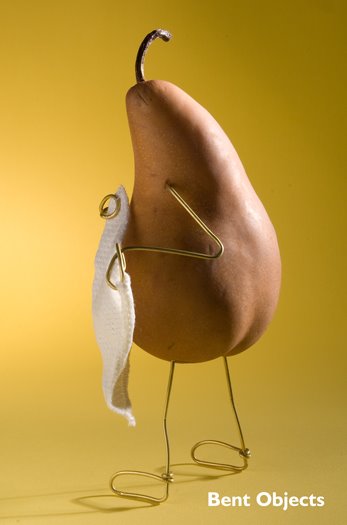
I've often been told I've a "wacky" or absurd sense of humour, inherited from Dad I suppose; I also find very basic, probably puerile, things quite funny. Terry Border is an American photographer and humourist who started creating ridiculous scenes with fruit, veg and household objects about six years ago. Using wire to manipulate and pose his apples, cornflakes and muffins in and out of context, his "Bent Objects" never fail to amuse me.
Terry Border subtitles his art "The secret life of everyday things", which I particularly love. My favourites are the cookie-crumbled who's down and out outside Tiffany's, the candle burning itself at both ends, the enthusiastic (hot)dog who's messed on the newspaper.
There's incongruity and the ridiculous all round us in this world. Just as I look back at photos of my PVC, pacifist-vegetarian-punk trousers and day-glow micro-mini skirts, future generations with an evolved sophistication will refer back to our hopes, fears and ways of being. In fact, there's an innate sophistication and satire in Terry Border's observations. Perhaps my PVC jeans were really sartorial satire; maybe that's why they were so uncomfortable...
Imagination is so frequently dismissed as day-dreaming, yet it produces little sculptures of wit and wisdom such as the creations here. Four hundred years before Christ was born, still centuries before Leonardo Da Vinci was doodling helicopters in his spare time, the Ancient Greek philosopher Archytas was creating bird-shaped, self-propelled flying devices. Once you start to view what seems unlikely or impossible as magical or miraculous, you can see the world as the bright and endlessly benign haven it was intended to be.
"King of Wishful Thinking" is an old favourite sing-along of mine from another of my most loved films. Like my lovely friend Ellen, I know whole swathes of dialogue from the film "Pretty Woman"; actually I probably know all of it, for all the characters. Other friends dismiss it as an unsophisticated 90's "rom-com". Apart from being gently witty and affectionately acted by the leads, it has it's own message. It's Cinderella with a sharp twist: Prince Charming, who sometimes isn't that Charming because he is Sad, meets Cinderella, who has a Hidden Heart of Gold which must stay hidden because Cinders is a Hooker (not the rugby type). Essentially, the Hooker knows more about truth and values than the Prince; he thinks he's saving her but it could just be the other way round. Of course, they live happily ever after, which is totally absurd huh?
I've included the song here mainly for Ellen, but also because after sniffling and smiling my way through the film yet again, I've been singing it for days. I usually only sing in the shower: I thought of joining a choir but they wouldn't all fit in my bathroom.


"On almost any street corner the feeling of absurdity can strike any man in the face."
Albert Camus


terryborder.com


"King of Wishful Thinking"  Go West


"Kiwi getting ready for the Beach" (Terry Border)


Friday, 19 July 2013

Keep the earth below my feet


"The true object of all human life is play. Earth is a task garden; heaven is a playground."
(G.K. Chesterton)


Due to my technical difficulties in recent weeks, I've had thoughts for a particular post flapping around in my full little head since the feasts of the Ascension and Pentecost. I started thinking about our notions of heaven and earth and what store we might set by any separation or unity of the two.
The ascension of Jesus to heaven has always provided atheists and sceptics with massive heartburn. Bible critics point to the mythical cosmology of the New Testament in particular, citing the structural convenience of heaven above, earth as the middle ground and the depths of the underworld below; furthest removed from the celestial realm. Sceptics have also suggested that accounts of Jesus' ascension tidily discredited any possible ongoing claims of Jesus appearing within the growing Christian community. Yet the tradition of Jesus' ascension, professed in both the Apostles' and Nicene Creeds, is certainly accepted and respected across the Catholic, Orthodox and Protestant churches. The bodily ascension is seen as an obvious and unequivocal sign of Jesus' humanity and divinity, of his participation in our story and God's
power and love.
Jesus refers to heaven and the Father there throughout his ministry, accepting his inevitable return and promising us the same rise. Sounds a bit too pie in the sky to be feasible? We wordy humans refer to heaven constantly as we respond to both the minutiae and more unusual stresses or pleasant surprises in our daily lives. It's very, very hot in Brighton at the moment, but far from drawing comparisons with any fiery pit down below (and I don't mean the Antipodes), Brightonians and tourists alike exclaim that this is "heavenly weather", "heaven on earth". My neighbour described her leafy back garden as "paradise" earlier.
 It seems most of us grow up with the notion that there is a heaven "up there": somewhere over the rainbow; even higher than the sky, beyond the sun, in another dimension; infinity and beyond. We can calculate and probe the centre of our earth; we can salvage from the ocean floor. We know how to make fire and usually how to put out flames. Yet no rocket can ever really touch the sky. "To infinity and beyond" may conjure up ethereal realms but nitty gritties such as maths and physics are always in the elusive mix. We can hazard a guess at what the Neanderthals preferred for midweek dinner, but we can't quite calculate the edges of the universe; where our world might end and another could begin.
I like the Pentecostal symbolism of Spirit enfolding air, water and fire: the rushing wind that heralds Spirit, the water of baptism and the tongues of flame that anoint and inspire the Apostles. I understand now that the fourth element, earth, is found in the Apostles themselves. Man is grounded and of earth itself. And it's essentially a wonderful place, unimagined and still misunderstood by us, for all our scientific and philosophical digging. Whether you subscribe to the Big Bang Theory, the Bigger Big Bang Theory, or believe in creation by a higher power, we did not make this earth which supports our vast ambitions alongside the most microscopic, ancient ecosystems. Of course there are inherent extremes of temperature and terrain across this planet, but so many of the world's crisis and problems are due to man's mismanagement and lack of safe-guarding.
People starve, not because of some vaguely discriminating natural law or the survival of the fittest. A huge proportion of the finest arable land is used to grow grain to feed an increased animal population to satisfy meat consumerism. In the United States alone, 175 million tons of cereals and vegetable protein, suitable for human consumption, is fed to livestock bound for just 28 million tons of animal protein, often in the form of "fast food".
I assure you this is not a vegetarian rant. In what we constantly refer to as developing countries, the use of land to create and maintain an artificial food chain has resulted in misery and famine for millions of our neighbours. One acre of land used for local cereal or vegetable production will respectively produce five and ten times more protein than one acre used for meat production for market elsewhere. In the case of crops such as soya, the probable increased protein yield is thirty times more.
The terrible human consequences of the shift of focus from food to feed were dramatically evident during the Ethiopian famine in 1984. Ethiopians starved in front of our TV cameras, but Ethiopia was harvesting a wealth of linseed and rapeseed for European livestock. We wept as the redoubtable Michael Buerk reported on famine and desolation on an epic, biblical scale. The region held by many to be the location of the Garden of Eden was described as "hell on earth".
Ordinary people responded with what was seen to be extraordinary kindness. A dishevelled potty-mouthed Oirish punk called Bob shouted, swore and sweated and celebrities suddenly found their own feet of clay could actually help kick political butts. The BBC and CBC footage from 1984 still makes me cry: as it did for so many other people, "Live Aid" changed me and the way I saw the world, man and God. I remember the concerts as though they were last week, not thirty years ago. Unfortunately, the famine in that region and others has proved endless. Charity surged and continues to flow but common sense and economic justice still don't amount to much for governments and the corporate world.
It's both a tragedy and a travesty that 80 percent of the earth's hungry children live in lands with food surpluses which are fed to animals bred for consumption by the affluent. It's a terrible irony that tens of thousands in the so-called First World die every year from diseases exacerbated by affluence: heart disease, strokes, diabetes and some cancers. Many years ago, a lovely old man in a loincloth and blanket pointed out that the earth has enough to sustain man's needs but not his greed; we nodded at Gandhi's wisdom and smiled at his naiveté.
On this glowing, fine day, I truly don't wish to put anyone off their barbecued beef or even their bean burger. Yet under the same unremitting blue sky, military experts warn today that Britain must "be prepared to go to war" in Syria to effectively end the conflict there and keep chemical weapons out of terrorist hands. The United Nations has already called the conflict in Syria the worst humanitarian conflict of the past twenty years, estimating 100,000 fatalities so far. Millions of Syrians have already fled or been displaced and hunger and disease breed in their tracks.
Man should never be prepared to go to war: it's a chillingly pointless statement when you strip away ideologies and strategies, flags and uniforms. We tend our gardens and man our borders for personal preservation. The ancient indigenous populations knew that we belong to the earth rather than vice versa; we are indeed borrowing it for and from our children. Herbaceous borders are lovely but boundaries and division confine as well as protect. It riles me particularly when people say:"You guys believe in God - why doesn't he stop the war?" God doesn't start war; if all men really believed in God, heaven and hell and themselves, they wouldn't start it either.
It's seen as human nature to seek comfort, provenance and heaven on earth. Walking across the Level here in Brighton, I see folk seeking enlightenment or oneness with the universe through various cultivated substances. The Sanskrit word "nirvana" literally means "blown out", as in a candle, referring to the stillness and peace of mind which remain after desires, dissentions and delusion are extinguished. But you can't drink your way to Spirit, or smoke your way to heaven.
I do believe that we encounter people, places and events that help us on our individual paths to heaven. If we're fortunate, we recognise our soul mates along the way. If we're blessed, our soul mates recognise us back. There's much beauty to be found on earth and much more to aspire to beyond. I believe we should embrace and cherish this world rather than reaching to pull the next down to us, like a fruit-laden branch to be plundered and muddied.
 

"On earth there is no heaven, but there are pieces of it."
(Jules Renard)


"Aim at heaven and you will get earth thrown in."
(C.S. Lewis)
 

"Below My Feet"  Mumford and Sons


"Keep the earth below my feet;
For all my sweat, my blood runs weak.
Let me learn from where I have been;
Keep my eyes to serve, my hands to learn."
(Dwane, Lovett, Mumford, Marshall)


"And forget not that the earth delights to feel your bare feet and the winds long to play with your hair."
(Kahlil Gibran)


Monday, 15 July 2013

Framed

 
"Some people see the glass half full. Others see it half empty.
I see a glass that's twice as big as it needs to be."
(George Carlin)

The German philosopher and writer Friedrich Nietzsche said that there were no facts, only interpretation. Not sure I agree with that one hundred percent, but I do believe that a scowl can often be seen as a down-turned smile. At the end of a trying, humid and heavy day in Brighton, I thought these pictures might just tug at the corners of someone else's mouth; in a good way.
Perspective and perception are not the same thing and can be either easy bed-fellows or ferociously divorced from each other. May your heart always see clearly what the sun or rain in your eyes has obscured. And if your glass looks empty, may you always find a friendly stream.
Thank you to John R. and Eleni for the photos.


"We can complain because rose bushes have thorns, or rejoice because thorn bushes have roses."
(Abraham Lincoln)

"The trick to forgetting the big picture is to look at everything close up."
(Chuck Palahniuk)
 
"If you look the right way, you can see that the whole world is a garden."
(Frances Hodgson Burnett)
 
"Everything Has Changed"  Taylor Swift & Ed Sheeran


Friday, 28 June 2013

The man and the supermoon

"Everyone is a moon, and has a darker side which he never shows to anybody." 
(Mark Twain)


"Man and the Moon", by Tina Palmer


"Moon River" 
(Johnny Mercer) 
Moon river wider than a mile,
I'm crossing you in style someday. 
You dream-maker, you heart-breaker, 
Wherever you're going I'm going your way. 
Two drifters off to see the world; 
There's such a lot of world to see. 
We're after the same rainbow's end, 
Waiting round the bend: 
My huckleberry friend, 
Moon river and me.

"Moon River" Audrey Hepburn ("Breakfast at Tiffany's")

Having finished work very late at the beginning of the week, I wandered off down the High Street in the wee hours, looking for the moon. It seems there are a lot of folk meandering up and down the Lewes Road at 1.30 in the morning, searching for the moon and other things. The moon, perhaps sensibly, was hiding behind a blanket of mist. From my own little street, this larger and brighter than usual moon was barely evident. I live in a low part of Brighton - probably in more ways than one - with steep banks of housing and buildings on either side. A full perigee moon always appears much lower on the horizon: it took three days until the June "supermoon" was on the wane before I could get a photo of it actually over the rooftops in my road.
Some stunning photos from across the world have been taken of the supermoon. I've posted some of them here; the last two are from Brighton; the final and by far the least impressive one is from my doorstep. I was determined to capture a bit of the supermoon: coinciding with the summer solstice and the full moon of St John's night, it seemed like a hopeful beacon. When I was little, my Dad of course told me there was a man in the moon who would know if I wasn't sleeping. Years later, I learned that The Man in the Moon is actually a traditional phenomenon as well as being a sentimental childhood essential.
I hadn't realised that for centuries across the northern hemisphere, the dark areas of the moon, the seas, in contrast to the lighter highlands have been perceived as human features. Maybe we need the moon to show a friendly face: earth's closest neighbour in space, it's comparatively large for a natural satellite orbiting a planet of this size. The moon is the brightest sight in our heavens after the sun, although in fact it's surface is dark, like coal and with a similar reflectance.
Old European tradition tells of a man being banished to the moon for some misdemeanor: Christian folklore depicts him as the man caught gathering sticks for firewood on the sabbath. Another Christian legend depicts him as Cain, doomed to circle the earth in exile, as depicted in Dante's "Inferno". In Norse mythology, the moon was a man in a horse drawn carriage, passing across the sky to escape a great wolf; in the Germanic and Roman cultures, he was also a thief of various descriptions, stealing away over the earth before daybreak.
In some eastern cultures, and particularly in Chinese tradition, the inhabitant of the moon was sometimes thought to be a stranded goddess, with only "moon rabbits" for company. Even today, Chinese children are shown how the features of the moon may represent the moon rabbit, rather than a man's face.
A prominent feature in our night skies and with a regularity of phases, the moon has gained a comforting familiarity since ancient times. The moon's orbit and gravity draw the ocean tides and the length of our days. Scientists believe the moon was formed shortly after the earth, from the fallout of debris and matter after we collided with something the size of Mars. The moon remains the only other celestial body that man has set foot on. Since the United States' Apollo 17 mission in 1972, only unmanned crafts have visited the moon, some confirming the discovery of lunar water ice - the moon's surface can't support liquid water. The Outer Space Treaty declares the moon to be free to all nations to explore for peaceful purposes; a sentiment that perhaps isn't honoured here on earth.
The moon has had a huge influence on folklore, language and the arts. Initially pushed into learning to play the piano when I was little, the first piece of "proper" piano music I grew to love was Claude Debussy's "Clair de Lune". As a fan of Mark Twain, I love the imagery of the song "Moon River" with even a "huckleberry friend". The song features in one of my favourite films, "Breakfast at Tiffany's", with Audrey Hepburn at her most adorable: half Irish and half Belgian and a bit kooky; what's not to like? I love the innocence of Hepburn's film version of the song, although Andy William's velvety voice was a perfect match to the poem and the melody. (I'd recommend looking up the film if you're not familiar with it, or have forgotten how magical it is).
The regular and distinct phases of the moon have made it a convenient and fascinating timepiece throughout history. The waxing and waning of the moon formed the basis of many of the most ancient calendars. The lunar cycle is approximately thirty days long and the English word for "month" and it's cognates in other Germanic languages originate from "the moon"; Germanic cultures relied on lunar calendars before any solar one. The oldest depiction of the moon is thought to be a rock carving at Knowth in Ireland, some five thousand years old.
In some ancient cultures, the moon was personified as a deity or supernatural entity. It has a long association with hopefulness and luck but also with emotions, irrationality and even insanity. The word "lunacy" obviously derives from the Latin name for the moon; even Aristotle, who wasn't short on marbles himself, believed the water component of the human brain must be affected by the moon's tidal power. Today, it's understood that the moon's gravity is too slight to affect an individual's brain function. Tales of increased accidents, homicides, suicides and psychiatric admissions at full moon persist but with little or no consistently supportied evidence. Certainly the euphoria and despair ill-met by moonlight on the Lewes Road most nights owe more to the influences and addictions of this world than the orbit of any satellite.
The full moon has always been emotive for me because it is simply beautiful, as distant and mysterious as it is predictable and symmetrical. My mother used to have me make a wish on the full moon, always starting "Dear God"; wishes, prayers all headed in the same direction. She also told me to turn coins over in my pocket at the new moon for prosperity. Walking down the main road in the first hours of the new day, I couldn't see the big moon for clouds and houses, but I did find the baby moon of a ten pence piece twinkling on the damp pavement.
The moon is a benign companion, to children, drunks, dreamers and doers. It's constancy and luminosity assuage childhood nightmares and adult loneliness. The magic of the night is part romance and part uncertainty and moonlight and moon-shadow will paint pictures that the day cannot sustain. As with everything serenely beautiful, it has an inexorable power, enough to pull the oceans from one shore to another. James Joyce spoke of the moon's "inscrutable tranquility". The same moon that appears to keep pace with me on my walks home at night along the Level will be lingering along with lovers by the Seine or guiding a lost backpacker somewhere unpronounceable. Even when we see the moon wane, it's size and shape remain perfectly the same. Every night, the moon is, generally, where we left it, just like our dreams.


"Three things cannot be long hidden: the sun, the moon, and the truth." 
(Buddha)


Starlings across the full moon at Brighton pier...

... and my own less spectacular photo of the this week's supermoon over my street. 


"Clair de Lune" ("Moonlight")  Claude Debussy

"Sometimes weak and wan, sometimes strong and full of light. The moon understands what it means to be human.
Uncertain. Alone. Cratered by imperfections." 
(Tahereh Mafi)


Friday, 21 June 2013

Each time you blink

 
 "While every refugee's story is different and their anguish personal, they all share a common thread of uncommon courage: the courage not only to survive, but to persevere and rebuild their shattered lives."
( Antonio Guterres, United Nations Refugee Agency)

Yesterday was World Refugee Day; very tellingly, I forgot about it, as many did. It took the often stunning but exhausting Russell Brand on last night's Question Time panel to remind me, and the audience. So often in these economically depressed times, the word is "Refugee" and yet we hear "Immigration"; and we feel the boundary.
A United Nations report issued this week confirms starkly that that we’re experiencing the worst refugee crisis in nearly two decades. Nearly 50 million are currently displaced from their homes due to conflict or violence. This is the highest number since 1994, when millions of people fled "ethnic cleansing" and genocide in former Yugoslavia and Rwanda.
The majority of today's refugees are originally from Afghanistan, Iraq, Somalia, Sudan and Syria. Beyond any scaremonger sloganeering from any political corner or hole, it may surprise many in the U.K. that the countries that historically have most opened their borders to refugees remain constant: Pakistan, wracked by its own crises; followed by Iran, Germany and Kenya. Turkey has joined the "top ten" list after giving refuge to an influx of Syrians, displaced by or fleeing the civil war.
The United Nations estimates that the war in Syria, now in it's third year, has forced 1.6 million Syrians into neighbouring Jordan, Lebanon and Turkey. They flee from a conflict which has so far killed nearly 100,000 people, crushed their homes, schools and businesses and denied their identity. They do not leave by any choice other than the will to survive and to see their children live. It's the same spirit which gets you and I out of bed in the morning, scratching and groaning, to grab breakfast and get the bus to work; minus the job, the bus, the breakfast and the home: insert fear and hunger instead. Later this year, the number of refugees from Syria alone will reach 3 million. For those of you who don't find the Bible believable or relevant to modern living, there are situations of epic displacement, persecution and exodus across the world right now.
As this summer solstice dawned, as with each new day, another 23,000 people began their own search for safety or refuge from persecution. Few borders are geographical rather than manmade; worldwide problems don't stop at checkpoints. Charity certainly should begin at home but the outside world which essentially houses all of us, does not begin or end at your own doorstep. Our world has a newly internally displaced person every four seconds. As Antonio Guterres, chief of the U.N.'s Refugee Agency says: "Each time you blink, another person is forced to flee,"


"On World Refugee Day, I call on the international community to intensify efforts to prevent and resolve conflicts, and to help achieve peace and security so that families can be reunited and refugees can return home."
(Ban Ki-moon, U.N. Secretary-General)

 "In my experience, going home is the deepest wish of most refugees."
(Angelina Jolie, U.N. Envoy)


"Seven Seconds" Youssou N'dour with Neneh Cherry