"Three things will last forever--faith, hope, and love--and the greatest of these is love."
(1 Corinthians 13:13)
Sometimes, things just fit together in this wee blog; just as sometimes in life, tiny baby steps take us to a place where the bigger picture may suddenly be hugely appreciable. I'm indebted to my gorgeous friend Christine, who I first met when we were mini-kilted convent girls and re-united with on here, for sharing the "Ten Ways to Love" with me. I'm also grateful to my new friend Anthony for sharing the wonderful "drummer" version of "How Great Thou Art", performed by members of the World Outreach Church. I don't know much about WOC, beyond that they're an interdenominational and pastoral ministry, originally based in Tennessee, USA: you can find them at: www.wochurch.org. As a frustrated drummer who hasn't got her bodhran organised yet, I've listened to this version of a much loved hymn over and over until finding the right post for it. The words and music here seem to compliment each other seamlessly; a real marrying up of the simplicity of little ways of grace and the greatness of being. And in fact, Christine's marriage to Colin and Anthony's with Abby are both inspirational unions: this post is for them. I've had a couple of friends moan that some of my posts are too long. This may or may not be shorter, but how long is a piece of string before it ceases to be a piece and becomes a length? Similarly, my sister and brother-in-law fret that my blog seems too Catholic; other Catholic friends, who are infinitely more learned about the church then me, feel "it isn't Catholic enough". All I can say is that I try to make this blog as open and honest as possible because that is what I crave from people and from life. Brighton, friends, being Catholic, animals, poetry, flowery frocks, Springsteen and treacle tart all make me happy. I suspect at least some of these things will make some other people happy too; for others, this humble blog will never be enough of one thing or may seem too much of the other. I'm actually hurting about something right now, critically aware of my own smallness. This blog generally and this post at this particular moment are my own little steps to the bigger picture; if it can soothe somebody else then I also feel blessed by that. The little steps in the Ten Ways to Love are literally as old as the hills on the Sinai Peninsula. They may appear removed from the grandeur and solemnity of the Ten Commandments, but look again. If we could all truly achieve these Ten Ways to Love, surely we wouldn't need to be reminded not to lie, cheat, steal or harm? May each sunrise bring you hope and every sunset, peace. May all your little steps bring you into being as great as you can be.
"How Great Thou Art" World Outreach Church
"Be faithful in small things because it is in them that your strength lies."
(Mother Teresa)
"Do the difficult things while they are easy and do the great things while they are small. A journey of a thousand miles must begin with a single step." (Lao Tzu) "For small creatures such as we the vastness is bearable only through love." (Carl Sagan) "Miracles are a retelling in small letters of the very same story which is written across the whole world in letters too large for some of us to see". (C.S. Lewis)
"One sees great things from the valley; only small things from the peak." (G.K. Chesterton)
"Every happening, great and small, is a parable whereby God speaks to us, and the art of life is to get the message."
"And think not you can direct the course of love, for love, if it finds you worthy, directs your course."
(Khalil Gibran)
Walking rather carefully across town today in the midst of an aggravating and aggressive dispute between Brighton Council and the city's refuse and recycling teams, I saw two families working together to clear the pavement and wash down the road themselves. Having accidently poured soapsuds all over my sandals, a lovely girl explained that her nan is getting married tomorrow and the reception will be held at her family home. The wedding was originally planned for Thursday 13th June - my own parents' anniversary. I explained this to Sarah and that was that really. Three fairy cakes, a pot of tea and a dozen introductions later and I finally stumbled back onto the Lewes Road to buy the stuffed vine leaves and olives I'd left the house for earlier.
I didn't meet Sarah's nan as she'd been taken to have her hair set and be generally pampered before her big day. Hella is marrying the typical "boy next door". Literally. The pavement in front of Hella's house was being almost surgically scrubbed by his two great-nephews. Hella's next door neighbour has never married and is now in his late eighties. I met Derek in Hella's front room, having one hand manicured ("emphasis on the Man bit you know"), while eating his fairy cake with the other. A seemingly confirmed bachelor, he moved next door to Hella and her first husband more than forty years ago.
Although he got on really well with the couple, he fell head over heels in love with Hella. Unable to say or do anything about his feelings and genuinely fond of her husband, he remained their loyal neighbour and best mate as the couple's three children presented them with four grandchildren and two great-grandchildren. He was their rock as Hella survived cancer twice and throughout her husband's catalogue of falls and strokes and his final illness; they nursed Derek through depression and after an almost crippling car accident. They tended each other's back gardens and even had a gate installed in the back fence for ease of access. Derek will now live in Hella's house and her son, Sarah's father, will move into Derek's house with his wife. Hella is in her early nineties now and not very mobile without a steadying hand and a lot of cajoling; her son and his wife had always intended to move closer to her when her husband died. Derek said he didn't want the hassle of selling his house and this way the two gardens can just become one. He thinks of the children as his own and his siblings are happy for everything to stay in the family.
When Hella's husband died last year, Derek sat with her, cried with her and cooked her roast dinners. He spoke at his friend's funeral and was stunned when the will revealed that he had left him care of his "most precious loved thing" - his wife. Apparently, Hella's husband had known of Derek's unspoken devotion for nearly half a century. In turn, he felt that his totally loyal wife had always had a soft spot for Derek. It took Derek two more days before he could find the words to tell Hella her husband had seen the truth. He said she cried, blew her nose, told him she loved him too but had liked and respected her husband and believed in marriage "Till death do us part". Now that it had, she said, Derek had better pop the question before one of them popped their clogs. Also, she wanted to catch up with Coronation Street that evening.
The couple decided to hold the wedding after the anniversary of Hella's first marriage, in April. It was postponed from 13th of June when the families realised that one of the many nieces would be in hospital that day. I was interested that they had originally chosen the thirteenth of any month; 13th June was the date that Derek moved in next door to Hella and her family so many years ago. I'd managed to maintain an element of composure until Derek told me this: I'd been thinking last week that my Dad wold have been married to Mum for more years than he'd actually lived. I told Derek I'd been to see Bruce Springsteen at Wembley Stadium last Saturday and taken Mum's photograph so that she could somehow be there, many years after she last saw The Boss play there, with me. This lovely old man, with his sea-coloured eyes and a penchant for having his plumber's hands manicured, told me that sentimentality was the echo of love and loveliness. He told me never to knock it; let it jolt you and you will always know you're still alive.
Beautifully, both families are delighted by the union. Derek was worried that Hella's son and daughters might think he was after her "for one thing".Money? He has his own. Her house? He already had too many rooms for one person, next door. Derek was concerned that as a lifelong bachelor, Hella's family might think the boy-next-door would be sniffing around for physical creature comforts. Derek said Hella soon sorted him out about this: "I don't just want to hold hands you know," she told him, "The kids would much rather I was tucked up here with you than going on the Lonely Hearts." Indeed. People often trivialise the physical or even emotional power of relationships between older or elderly lovers. That upsets me a lot; I believe that love makes even a failing heart beat faster. Romance and sexual love only have a sell by date if the relationship hasn't been blended properly. It's true that as you age, you can fully appreciate that com-passion is the sustaining flame born of communication and passion.
I'll be working when Derek finally marries his Hella tomorrow, although I may pop along for the reception and more fairy cakes. Derek told me they're not going away from Brighton at all, because every day will now be a honeymoon and also because for them, Love lives in their steep little street. I asked him if forsaking bachelorhood might be difficult: he said it would be "interesting"; seeing that Hella had found someone before him had been extremely difficult, but not being with her when she was on her own would have been unbearable. He said he was an old dinosaur but he just wanted to be loved; I immediately thought of the Edward Monkton poem that featured in the recent wedding of the youngest daughter of my friends, Ellen and Tom. I'd never heard it before, although I'd seen some of Monkton's greetings cards and cartoons. I've included it here as a childlike celebration of unconditional romantic love, with all it's simplicity and intrigues. We're basic creatures but capable of the most noble sentiments.
I didn't get my dolmades after all, although I think I found something much richer and more filling today. The deli had sold out; I was still a bit teary-eyed and I think the kind Turkish shop-keeper thought I was upset about my failure to gather supper. He gave me some veggie pate for free instead. I tried to be honest and explain but it made me blub again and he started to look wary. I thanked him, smiled and took the pate. Which was delicious with pitta and olives. See: basic creatures.
" A Lovely Love Story"
(Edward Monkton)
The fierce Dinosaur was trapped inside his cage of ice. Although it was cold he was happy in there. It was, after all, his cage. Then along came the Lovely Other Dinosaur. The Lovely Other Dinosaur melted the Dinosaur’s cage with kind words and loving thoughts. I like this Dinosaur thought the Lovely Other Dinosaur. Although he is fierce he is also tender and he is funny. He is also quite clever though I will not tell him this for now. I like this Lovely Other Dinosaur, thought the Dinosaur. She is beautiful and she is different and she smells so nice. She is also a free spirit which is a quality I much admire in a dinosaur. But he can be so distant and so peculiar at times, thought the Lovely Other Dinosaur. He is also overly fond of things. Are all Dinosaurs so overly fond of things? But her mind skips from here to there so quickly thought the Dinosaur. She is also uncommonly keen on shopping. Are all Lovely Other Dinosaurs so uncommonly keen on shopping? I will forgive his peculiarity and his concern for things, thought the Lovely Other Dinosaur. For they are part of what makes him a richly charactered individual. I will forgive her skipping mind and her fondness for shopping, thought the Dinosaur For she fills our life with beautiful thoughts and wonderful surprises. Besides, I am not unkeen on shopping either. Now the Dinosaur and the Lovely Other Dinosaur are old. Look at them. Together they stand on the hill telling each other stories and feeling the warmth of the sun on their backs. And that, my friends, is how it is with love. Let us all be Dinosaurs and Lovely Other Dinosaurs together. For the sun is warm. And the world is a beautiful place.
"Love Monkey", a five minute film based on the book by Edward Monkton.
"Allelujah" Fairground Attraction
"Your smile is a prayer that prays for love and your heart is a kite that longs to fly; Allelujah here I am- Let's cut the strings tonight, and we'll kiss the first of a million kisses"
( Mark Edward Nevin)
"You don't have to go looking for love when it's where you come from." (Werner Erhard)
"Trust yourself. Create the kind of self that you will be happy to live with all your life."
(Golda Meir)
(All photos: Gigi, album) My Dad Tony with Mum in his native Belgium.
Today is the anniversary of my Dad's passing and he's now been apart from this seen world for more than half of my lifetime. One of the things I remember most strongly about him is laughter and indeed his laugh. For a man who was not tall and who was non-confrontational and contemplative by nature, Dad's laugh was big, sudden and random. He was generally softly spoken but he laughed like Sid James. American writer Anne Lamott once said that laughter is "carbonated holiness": I can see my Dad was a very spiritual man who was capable of great joy in small things. There was an honesty in Dad's laugh. So often, I'm aware of manufactured giggles and mannered groans. Hunour these days often seems so structured and sophisticated, even class conscious. I've inherited Dad's very out-of-the-box sense of humour; it encompasses the bizarre and the slapstick and the everyday ironic. I often open up one of his belly laughs; my mother used to think it was something of a curse in a woman but now I feel it's a blessing; my Dad's little route-finder for joyfulness. My Dad was a deep thinking and well read man but was completely free of pretension; he had no real material aspirations either, although he always wanted to do the best for my mother, and later on, for my sister and me. My Dad may have blushed a little bit about Brigitte Bardot, Bernadette Devlin (now McAliskey) and that blonde bird from Abba, but Mum was the love of his life. My Mum was aware that he'd been quite inexperienced romantically before her and he seemed to wear his faithfulness like his favourite tweed teaching jacket.
He'd been nearly halfway into a monastery when he met Mum; I can see how the tranquility and humility of the monastic life had appealed to my father. Lord knows what they would have made of his laugh. My father settled into teaching, interpreting and translating. His little study at home in south London was packed with books, newspapers, postcards from various monasteries and his cassettes of Gregorian Chant. Mum sometimes despaired of his lack of personal ambition later in life, but I realise Dad was always aware of the bigger picture from his little corner in it. It sounds cheesy, but he had high hopes for the world.
"Conscience is God present in man."
(Victor Hugo)
Dad with my sister.
After Dad died, I felt I envied my sister the quality one-to-one time she had with him when she was little. Once the family left Belgium for London and I was born, my Dad was always working; never less than two jobs and sometimes as many as four. When I was about seven years old, Mum would often go out on Saturdays, from lumchtime until the shops closed, with my Auntie Barbara and my sister, who was then fifteen going on twenty five (complete with heels and Audrey Hepburn cigarette holder). Still with yellow plaits and plastered knees, I felt very un-grown up and initially very left out: my Dad would be in his study for most of the day, translating and marking students' papers. But it became an easy habit that my Dad would emerge in time for the football results; even though Dad's idea of sport was "It's a Knockout"). He would make beans on toast or grilled kippers (these were the days when I couldn't even spell vegetarianism) and strong, sweet tea and we would watch "Doctor Who" together. It occurs to me now that we didn't say very much; I would watch the good Doctor avidly while my Dad chuckled or tutted. He never picked up a newspaper or a book or looked bored. It was hugely comfortable and comforting just to sit quietly. I've realised across the years just how like my father I am. I love to laugh, I love music, colour and cleverness, but sometimes it's just lovely to be still and safe in your own company or with someone close.
"Laughter is the sound of the soul dancing. My soul probably looks like Fred Astaire."
(Jared Kintz)
In Northern Ireland: Dad with his Poirot-style moustache, with my sister holding one of the baby cousins; my cousins Lucy and Charlie Joe are in front of him. I'm playing with my hair as Mum looks on from the doorway.
I'll acknowledge that I was usually described as being academically bright; it was quietly anticipated by my parents that I would probably follow Dad and become a teacher of some variety. I was never the kind of little girl who said she wanted to be an air hostess or even a princess. I wanted to be Tarzan's Jane at one point and then of course Dr Who's next lovely assistant. When I was in my early teens, at convent school and also having gone through all my preliminary dance exams, I announced that I wanted to be a nun or a ballerina. My Mum was exasperated and said I would do neither; that I was an eejit and would have to speak to my father. He was very calm about it all and didn't appear phased by the propositions of having a daughter in cloisters or on stage in tights. Having asked me why I felt I should or could do either, he simply said that from his point of view, it appeared that I could be a dancer and still pray, but that he didn't think there was a whole lot of pirouetting in most convents. He also told me I didn't have to be anything, but that I should try to do something with my life. He told me I didn't need to do anything other people might think of as "big" just for the sake of it. My Dad liked Victor Hugo's concise eloquence; he felt that death was really nothing, but not to have lived your life must be terrible. Although he was a non-judgmental man, rights and wrongs were black and white to my father; he was assured of his own responses and responsibilities. He had a generosity of spirit and a talent for people that I feel made it very difficult to dislike him. Certainly, Dad didn't seem to have a bad word to say about anyone, although his sense of injustice was relentless. I hope I've inherited some of the latter at least: I take it as a compliment when I'm dismissed as an "effing do-gooder". I haven't done anything big with my life and may never do. I can see now that my Dad could have been a writer, but he was essentially content with what some might have called the minutiae of his life. In the Great Scheme of Things for other folk, my Dad may not have done anything big: his home and family became his vocation. Yet after he died, I discovered Dad had funded several students in Africa so they could change their lives. His letters to various publications about injustice in Northern Irish politics brought him to the attention of both the paramilitaries and Scotland Yard. He was regularly sent jokes by Bishop Desmond Tutu; they carried on corresponding after Dad taught the bishop languages. Dad called him Des. And Des has that same unexpectedly raucous laugh that Dad had, that delightful burst of animation in the midst of such gentleness. I once described my Dad as a mixture of Desmond Tutu, Richard Briers and Hercules Poirot, but essentially he was very much his own person. I know now you can't be true to another person or to your God without being true to yourself. Because of Dad, some things will always be very black and white to me: love, truth, faith, justice. For a quiet, not-tall guy, my father probably had all the biggest things covered. When I was little, my Dad would often play records on Sunday afternoons; music that both he and Mum had been moved by over the years. In between the Irish Rebel Songs, Edith Piaf, Jim Reeves and Abba, there would usually be The Seekers; two songs in particular. Since both my parents died, I can't hear "The Carnival is Over" without dissolving. On the other hand, I've never found their version of Tom Springfield's "Another You" anything other than joyful. It sounds like an affirmation; I always feel it reminded my parents of how they met. It reminds me of how I still want to live my life. Sometimes. things really can be that simple.
"Do your little bit of good where you are; its those little bits of good put together that overwhelm the world."
"And the light shineth in darkness; and the darkness comprehended it not."
(John 1:5)
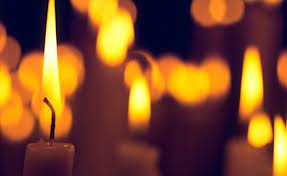
This post is a little late, due to demands of work, but I've felt compelled to complete it. On Good Friday, I attended a beautiful "Tenebrae" service, a Service of Shadows, and it's left a lasting impression on me.
"Tenebrae" is Latin for shadows or darkness. The Tenebrae has evolved from an ancient Christian ritual, most usually held on Good Friday, using diminishing light through extinguishing candles to symbolise the arrest, torture, trial, crucifixion and burial of Jesus. The enveloping darkness holds the sadness, helplessness and hopelessness after his death; a world without God. When I was at school, the Tenebrae would include a dramatic slamming of a church door or other dramatic noise to signify the closing of Jesus' tomb.
I remember Tenebrae services from my younger days as sombre and deeply sad; even depressive, if I'm being totally honest. This Good Friday, I travelled to the parish of "Our Lady of Mercy and St Joseph", in Lymington in Hampshire, to take part in a beautiful service put together by the wonderful Cathy; assisted by the lovely parish priest, Father Danny. Although Tenebrae has evolved with many traditional and orthodox elements intact, the service at Lymington was incredibly effective.
Belying the hard work that had gone into the preparation, it was a simple and seamless Tenebrae. About forty people attended on what was essentially a cold Friday night; the pretty parish church is quite small and seemed almost womb-like by flickering candlelight.
The service was obviously reflective and moving, but the beauty of it has stayed with me throughout Easter and is carrying me through the start of the great British summertime. I felt a real sense of quiet hopefulness during and after the service. At the edge of the New Forest and set across the Solent from the Isle of Wight, Lymington is often depicted as an affluent, self-contained area. But the quayside shops and pristine cottages front a town still darkened by poverty and social distress; the community of Our Lady of Mercy responds from a little pocket of kindness which is incredibly deep.
The intent of the service and the openness with which it was received were palpable. It's traditional to leave the Tenebrae in silence; the gathering on Friday in Lymington stayed in hushed contemplation long after the last candle of the service was blown out. There was a very real sense of acceptance and renewal and the affirmation of the faith at the heart of Easter. It was one of the most poignant church services I've been to: impossible not to feel touched by the spark made only brighter by the winter darkness.
"It is a time for shadows.
Before the glorious light of resurrection morning,
there are dark nights, and even darker days.
On our way toward rejoicing in the resurrection,
we are entering that shadow land, those days of darkness,
the darkness that stretched from the upper room to the tomb.
Dark days lie ahead,
somber days, shadowed days.
We have asked terrifying questions:
Will we notice the light, in the midst of so many shadows?
Would we notice the light, were it not for the shadows?
But we have ended with the triumphant question:
Would there be shadows, were it not for the light?
It is a time for shadows,
But it is also a time for hope."
(Adapted from Lee Magness' "Service of Shadows" 2009)
"There is a fragrance in the air, a certain passage of a song, an old photograph falling out from the pages of a book, the sound of somebody's voice in the hall that makes your heart leap and fills your eyes with tears. Who can say when or how it will be that something easters up out of the dimness to remind us of a time before we were born and after we will die?"
(Frederick Buechner)
"John Nineteen Forty-One", from "Jesus Christ Superstar"
White smoke from the chimney at the Sistine chapel in Rome about three hours ago signified to the world's one billion plus Catholics that we have a new Pope. I'm so glad to see the Conclave decide relatively quickly: this feels definitive and positive; reassuring in the face of the recent divisions within the Church and derision from without.
Cardinal Jorge Mario Bergoglio, from Argentina, is the 266th Pope: the first Latin American pontiff; the first non-European to be elected in over a thousand years, the first Jesuit Pope, the first Pope Francis. His initial address to the euphoric crowds was confident but humble: it also felt very personal and indicative of the man. He not only gave the traditional blessing but asked the people to pray with him and for him and for Benedict, the Pope Emeritus. I found this very touching. He likened his election to being "fetched" from the very edge of the world. Around forty two percent of the planet's Catholics are from Latin America, although Catholics have notably been leaving the faith in that region in recent years. It seems significant that our new Pope hails from the developing world.
As a Jesuit, the former Cardinal Bergoglia will be used to looking after himself and living a no-frills existence. He's a Vatican diplomat but is not a university professor type. Regarded as an exceptionally spiritual man, he rides the bus in Buenos Aires from his simple apartment where he cooks and fends for himself, eschewing the more luxurious accommodation and private limousine afforded to cardinals. Of course, this simple life will necessarily change now: hopefully the man will not.
Known to many in Buenos Aires as "Father Jorge" as he visits the poor, he's created new parishes and restructured administration; no mean feat itself in bureaucracy riddled Argentina. A man of quiet but firm voice, he's been outspoken on many issues, including same sex marriage. In 2010, when Argentina became the first Latin American country to legalise marriage between same sex couples, Father Jorge actively encouraged the clergy and the people alike to continue to protest. At seventy six years of age, he is perhaps an older new Pope than many of us expected. He was actually the runner-up of the last Conclave in 2005, with the second highest number of votes in all four ballots at that time. He became Archbishop of Buenos Aires in 1998: his role there has often involved speaking publicly about economic and social distress. Although not overtly political, he hasn't hidden the social and political impact of the Gospel in a large country rocked by economic crisis and with a history of social injustice. He studied Liberal Arts in Chile and has a degree in philosophy and a master's in chemistry. In 1973 he was elected Superior of the Jesuit Province of Argentina. The Jesuits are traditionally "God's Marines": an evangelical, apostolic ministry which today spans more than a hundred countries across six continents. Spanish-born missionary St Francis Xavier was one of seven men along with founder St Ignatius Loyola who pioneered the Jesuit way. In 1534, they professed their vows of poverty and chastity and a special vow of devotion to the Pope. The new pontiff's break with tradition in choosing to become the first Pope Francis may reflect this Jesuit background. Alternatively, he may have chosen the name in honour of St Francis De Sales, the mystic and educator; or of course St Francis of Assisi, the gentle patron of animals and the environment. What has become clear is that this Pope is a grounded man of humility and a pastor at heart: truly what the Catholic Church has called for at this time.
"Look at how a single candle can both defy and define the darkness."
(Anne Frank)
"How far that little candle throws his beams! So shines a good deed in a weary world."
(William Shakespeare)
Yesterday was the beautiful, melancholic Christian feast of Candlemas, recalling when Mary was purified and blessed after childbirth, so that she could return to the Temple and present her baby Jesus there for the first time. When Mary and Joseph arrived at the Temple, one of the elders, Simeon, held the baby up spoke of him as the Messiah, "the light". The obvious significance of the feast of candles is that Christ is forever the Light of the World. As well as the church candles being blessed at Candlemas, when I was at school, people brought their own candles to church for blessing; I'm not sure how often this happens these days. Sometimes we all need a little help re-igniting or nurturing that spark of hope or love, to keep it burning through all weathers. Before the birth of Christ, the pagan Celtic festival of "Imbolc" was celebrated at this time. Imbolc began at sunset on 1st February, itself the celebration of the pagan goddess Brighid, which would eventually become the Christian feast of St Brigid. "Imbolc" translates as "in the belly", referring to a time of renewal and the promise of abundance from the earth goddess. Imbolc marked the halfway point between the darkness of the Winter Solstice in December and the new light of the Spring Equinox in March. Fire played a huge part in the pagan festival; as well as being purifying, it signified the increasing power of the sun as the days lengthened. Christians began celebrating Candlemas as early as the fourth century. It's a bittersweet celebration; looking back to the recent joy and gift wrapping of Christmas, drawing breath before the penitential self denial of Lent.
According to folklore, around Candlemas, snowdrops,"Winter's Bells", start blooming and the badger emerges, both heralding the beginning of the end of the cold weather. Sometimes frowned upon by the part of me that's trying to be a proper Catholic, the Irish in me is delighted by "signs". The first snowdrops in my garden are already pushing through the stones and slushy aftermath of winter. I told a friend a couple of days ago that I'd seen a badger snuffling around the undeveloped land at the back of my house; I thought I saw one late last year as well. He wasn't convinced, but yesterday I learned from one of our very own local elders that we have a large, established badger colony in Brighton. I live very close to a convergence of cemeteries and burial grounds: the old boy confirmed that these gruff critters grunt around the grounds at night, probably fueling Brighton's many urban ghost stories. (Personally, inspite of my proximity to the cemeteries, I would be more worried that anything shuffling about in the dark behind my house was an inept burglar: I don't believe the dead can hurt you, much as the living might try). A little digging on t'internet when I got home unearthed (sorry) a short film that Alan Titchmarsh made a couple of years ago, describing Brighton's badgers as "some of the city's oldest inhabitants". I have a feeling that my badger will turn his snout up at my veggie curries and felafel balls, but I'll be watching out for him. Whether we admit to being superstitious or not, I'd hazard that we all look for signs from time to time: signs that we're doing the right thing, going the right way; signs that we're loved, that our lives have any meaning. Some signs are far more subtle than the obvious neon, flashing or dayglo varieties. I believe we each have our own light to shine; often an illuminating sign to ourselves and others, frequently taken for granted. When you watch children at play, no scenario seems impossible to them; they sparkle because they can and because nobody has yet told them they shouldn't. When we allow our own light to show, we unconsciously give that sign to others to do the same. Not all of us are electrifying: some of us are more like twinkling candles, but one tea-light can set dozens of candelabras blazing. Obviously, I believe that spark is God-given. We should never let anyone try to extinguish our own light: sometimes we feel relegated to the shadows, but the smallest glimmer can guide or define us in the gloom. During the past week, we've had severe problems with electrical power in my street.: there are now two large holes on opposite sides of a very small road and a very noisy mobile generator appeared to be running the show until Friday. I'm a real sucker for candlelight and have sconces and tea-lights a go-go. I'm largely unphased by the lights going out, although less keen on the prospect of stone cold water and an uncharged laptop. To be honest, part of me (probably that Irish bit again) is a little disappointed that the street wasn't a flickering little settlement of candlelit windows this Candlemas. I decided to refrain from hitting the light switch yesterday afternoon to watch the opening matches of the Six Nations Rugby. Anyone glancing through my front window would've caught me cussing at the referee by candlelight, with the added incentive of the heady scent of ginger and sandalwood. We take electricity for granted on a daily basis, until we're forced to rely on a more basic source of power again and rediscover our childhood wonder for the flame.
"We can easily forgive a child who is afraid of the dark; the real tragedy of life is when men are afraid of the light."
(Plato)
"Thousands of candles can be lighted from a single candle, and the life of the candle will not be shortened. Happiness never decreases by being shared."
"God said: “Let there be lights in the dome of the sky, to separate day from night. Let them mark the fixed times, the days and the years, and serve as luminaries in the dome of the sky, to shed light upon the earth.” And so it happened: God made the two great lights, the greater one to govern the day, and the lesser one to govern the night; and he made the stars. God set them in the dome of the sky, to shed light upon the earth, to govern the day and the night, and to separate the light from the darkness. God saw how good it was. Evening came, and morning followed."
(The Book of Genesis 1:14)
I shall be working this New Year's Eve, until around 11pm - I'm grateful for it and would rather be earning than not, whatever the time of day or year! But I'm mindful of the significance of this evening, and tomorrow's dawn. I won't be one of the very hardy Brighton eccentrics who traditionally take to the sea in the January wind and rain on New Year's morning. But I am enough of a Brighton eccentric to want to walk down to the pier and along the pebble beach in wellies by myself tomorrow morning; it's one of the practical pleasures that drew me to this city in the first place.
Beyond that, I've resolved this year not to make New Year resolutions as such: I'd rather concentrate on what I need to do to enable what I want to happen in my life. Oscar Wilde said that resolutions at New Year are: "simply checks that men draw on a bank where they have no account.” I've learnt a lot about myself and the people around me over the past year; some of it, I've even liked. I'm hoping to grow to be more accepting of the things I don't readily like or even acknowledge. At the end of any day, not everyone will or should like me; but then only I have to be comfortable in my skin as I settle down with my cup of Redbush and an unseemly large piece of treacle tart. For someone who's spent most of her adult life dreading criticism about their clothes, this is progress. I realise that since starting this blog in February, I've surfaced as a kind of hybrid of Anne of Green Gables and Mrs Doyle found reading The Guardian on a long train journey. Luckily, I'm partial to all of these ingredients. It may not have been quite what I was expecting, or indeed everybody's cup of Redbush, but I believe it could have been a lot worse.
"May the nourishment of the earth be yours,
May the clarity of light be yours,
May the fluency of the ocean be yours,
May the protection of the ancestors be yours.
And so may a slow wind
Work these words of
love around you,
An invisible cloak
To mind your life."
(From "Beannacht - A New Year's Blessing", by the late, wonderful John O'Donohue)
"We will open the book. Its pages are blank. We are going to put words on them ourselves. The book is called Opportunity and its first chapter is New Year's Day."
(Edith Lovejoy Pierce)
"The object of a New Year is not that we should have a new year. It is that we should have a new soul."
(G.K. Chesterton)
"Cheers to a new year and another chance for us to get it right."
(Oprah Winfrey)
"New Year’s Day… now is the accepted time to make your regular annual good resolutions. Next week you can begin paving hell with them as usual."
(Mark Twain)
"For last year's words belong to last year's language And next year's words await another voice."
(T.S. Elliot)
"Write it on your heart that every day is the best day in the year."
(Ralph Waldo Emerson)
"No one ever regarded the first of January with indifference. It is that from which all date their time, and count upon what is left. It is the nativity of our common Adam."
(Charles Lamb)
As a longtime fan of Robbie Burns, I love "Auld Lang Syne". He wrote the poem and set it to a traditional folk tune in 1788, yet it endures today across the English speaking world; at funerals and memorials, graduations and farewells and of course on New Year's Eve. The Scots title translated into English is simply "Old Long Since"; days gone by. I care not a jot that it's been done to near death by any performer with half a tonsil, nor that Burns probably plagiarised a couple of 16th century folk songs to construct it: it is remembrance and rekindling in all simplicity. Included below is probably my favourite version, sung as Burns would have wanted to hear it.
"And surely you’ll buy your pint cup
and surely I’ll buy mine!
And we'll take a cup o' kindness yet,
for auld lang syne.
And there’s a hand my trusty friend
and give us a hand o’ thine!
And we’ll take a cup o' kindness yet,
for auld lang syne."
"Auld Lang Syne" Paolo Nutini
Personally, I wish you all everything that you would wish for yourselves, but also every blessing and good thing that you may not know you yet require. May you wake tomorrow knowing your own name and those of your truest friends. If you cannot give a name to God, may you be at peace with those who do, whatever that name may be. Be as good as you can be on any day, believing that both you and the world can be better still tomorrow. I hope your journey this past year has brought you closer to yourself and shown you that you can allow yourself and others a little more kindness in the next one. Slainte, Namaste and God Bless X
I'm indebted to the lovely Anne, who has enabled me to slip a post in before Christmas which includes a gorgeous Native American blessing, my favourite version of one of the most beautiful tunes ever and an excuse to mention Jimmy Stewart. Yes, that Jimmy Stewart. Anne is apparently a little bit Cherokee and a little bit Iroquois as well as being a lot of Oirish. She's a ginger too; I like to think that her particular genetic blend means she likes the wearing of the feathers when she's in a good mood but will surely spit some when she's rattled. She enjoyed the post on here about the feast of Thanksgiving and has sent me a beautiful Iroquois prayer and the "Sacred Instructions", holy commandments really, which the Native American people believe were handed down from the Great Spirit at the time of the Creation. I'm very drawn to the Native American heritage and beliefs which have a richness as well as a simplicity; I've added a couple of my own favourite sayings here, I hope Anne won't mind.
Her mother's ancestors lived in West Virginia, home of the Blue Ridge Mountains, the Shenandoah River and it's valley, Appalachian bluegrass music. Yet another place I've long romanticised in my head and feel in my heart that I will still find a way to. The name "Shenandoah" is of unspecified Native American origin. It may have evolved from the Iroquois word for "Big Meadow", but probably the most popular belief is that it derives from a Native American expression for "Beautiful Daughters of the Stars", referring to the flow and tides of the Shenandoah River itself. The song "Oh Shenandoah" became popular with slaves and also with sailors as a sea shanty in the mid 1800s. Some folk believe the lyrics tell the story of a European trader in love with the daughter of an Indian Chief; others, of a Confederate soldier dreaming of his country home: Virginia was a key region during the American Civil War. I favour the theory that the singer is expressing his love for the moods of the great river itself: "Oh Shenandoah, I love your daughters". There are so many lovely versions of the song, but Van Morrison's with the Chieftains is especially epic and really tugs at my heartstrings. The song features throughout my favourite Western, also called "Shenandoah", starring Jimmy Stewart as the widowed patriarch of a large Virginian family. Inspite of my mistrust and dislike of guns, I have a soft spot for some of the valiant, big-country, old cowboy films; and my old cowboy of choice would be Jimmy Stewart. The film is wonderfully evocative, essentially anti-war, pro-family and pro-faith. Native American faith finds Spirit in all things, all creatures and the elements. The Great Spirit, God, is viewed as the eternal animating force of the universe; therefore, there is divinity within everyone and everything in the universe. Thanks and praise have traditionally been offered to the crops harvested and the wildlife hunted for food and the unseen spirit world is ever-present. Thank you for the prayer Anne; have a blessed and peaceful Christmas.
"Iroquois Prayer"
"We return thanks to our mother, the earth, for sustaining us.
We return thanks to the rivers and streams, which supply us with water.
We return thanks to all herbs, which furnish medicines for our care.
We return thanks to the corn, and to her sisters the beans and squashes, which give us life.
We return thanks to the wind, which has moved the the air to banish all ills.
We return thanks to the moon and the stars, which have given us their light when the sun sleeps.
We return thanks to the sun, that looks upon the earth with a beneficent eye.
Lastly, we return thanks to the Great Spirit, in whom is embodied all goodness, who directs all things for the good of his children."
Sacred Instructions
Take care of Mother Earth and of all the other colours of man.
Respect Mother Earth through all creation.
Honour and support all life.
Be grateful for your life, and your survival.
Love long and well, and express that love.
Be humble. Humility is the gift of wisdom and understanding.
Be kind with one's self as with others.
Be honest with one's self and with others.
Be responsible for these sacred instructions and share them with other nations.
"Certain things catch your eye,
But pursue only those
that capture your heart"
(Cherokee proverb)
"The sun would have no rainbows if the eyes had no tears"
(Cherokee)
"If you must beg, knock only at large gates"
(Native American)
"Lose your temper and lose a friend, lie and you lose yourself"
(Apache proverb)
"Oh Shenandoah" Van Morrison and The Chieftains
"The dead live on, in the hearts of those they live behind"
(Apache saying)
"May your mocassins make happy tracks in many snows,