Showing posts with label Catholic. Show all posts

Sunday, 2 February 2014

The ride: Chinese New Year

 
"If you hurry through long days, you will hurry through short years."
 (Chinese proverb)

Friday 31st January saw the start of the fifteen days of celebration of the Chinese New Year, also known as "Spring Festival". Welcome to the Year of The Horse. I went to my local Morrison's to hunt and gather vegetarian spring rolls and chilli rice crackers on Friday, only to find they'd sold out of both.
"For Chinese New Year I suppose?" I suggested to the pretty and very eager sales assistant.
"Oh... I don't know. What is it?"
"Year of the Horse," I said helpfully. She suddenly looked quite disturbed.
"No! No we weren't one of those shops. We never sold that!"
She carried on glaring at me as I scuttled off to capture my blueberries and M & M cookies.
Catholics aren't supposed to set any store by horoscopes; this I know and appreciate. But my mother was an Irish Catholic and very much an Aries; therefore she maintained that most horoscopes were rubbish and never came true but read them religiously (pun intended) everyday to see just how rubbish they were and anyway, Aries people were strong and passionate and made the best Catholics. When I was thirteen, a lovely old nun called Sister Mary Clare remarked on my birthday that I was most unlike any Piscean she had ever encountered; apparently more feisty and strong-minded. She deduced I must have had "a lot of rogue planets around" when I was born. Indeed.
She also remarked that I must be more like my Chinese horoscope, confirming that I was born in the Year of the Tiger. Tiger people are allegedly fearless to the point of being rash; lively minded and kind, but will always go their own way, often against all advice. Energetic, but prone to injuring themselves... There's also a Chinese saying that once you jump on the back of the tiger, you may find it impossible to get off in one piece. Hmm. Well, I've always loved the character of A. A. Milne's Tigger; he also liked to jump up and climb things with no real idea of how to get down again.
I read today that Tiger people have a special affinity with Dog, Dragon and Horse folk. The Year of the Horse is said to be one of strong ideals and opinions surfacing and emotions bubbling away under the surface until they must erupt. Typically, it's said to be a year of shocks and volcanoes. Sadly, I was pondering this as I heard the news about Mount Sinabung erupting in North Sumatra, Indonesia, killing at least fourteen people.
 The Chinese zodiac is based on the five elements of earth, water, fire, wood and metal which influence the universe and interact with the twelve animals of a cyclical zodiac, resulting in specific characters for the year of that animal and those born at that time. This is an ancient calendar system, originating in the Han dynasty about two hundred years before the birth of Christ.
Those born in the Horse's year can be expected to be active, animated and independent. I for one hope this year proves to be all of those things, but also one of great peace. The past year seems to have been one of division and strife, with increasingly loud  but vacuous celebrities, bigots and politicians... Yet last year the Catholic Church found in Pope Francis an active, animated and independent pontiff; also a man who promotes great peacefulness in all that he says and with all that he does. He was born in the Year of the Rat; Catholics are probably not meant to calculate their pope's Chinese birth-sign either. Must be the Tiger in me.
Unable to find my spring rolls, I've gathered together some old Chinese proverbs from various sources. They sing true individually but also sit together beautifully and read like a very spirited prayer. Whatever your sign or symbol, may truth be the most fitting element for us all this year.


"Chinese Proverbs for the New Year"
"When the wind of change blows, some build walls; others build windmills.
No wind, no waves.
If the wind comes from an empty cave, it's not without a reason.
Teachers open the door. You must enter by yourself.
Don't fear going forward slowly; only fear the standing still.
A book that remains tightly shut is simply a block of paper.
Deep doubts grow deep wisdom.
Better to have a diamond with a flaw than a pebble without one.
You may dream different dreams while always sleeping on the same bed.
Not only can water float a boat, it can also sink it.
An ant may well destroy a whole dam.
Better to light a candle than to curse the darkness.
Only one who can swallow an insult deserves to dine like a man.
Good medicine often tastes the most bitter.
Do not use a hatchet to remove a fly from your friend's forehead.
With true friends, even water drunk together is sweet enough.
A dog won't forsake his master because of his poverty; no babe ever refused his mother's breast because of her homeliness.
There is only one pretty child in the world and every mother has it.
Not the cry, but the flight of the wild duck, leads the flock to follow.
Not wine: men intoxicate themselves. Not vice: men entice themselves.
Mankind fears an evil man but heaven does not.
If heaven made someone, earth can find some use for them.
If you want happiness for an hour, take a nap. If you want happiness for a day, go fishing. If you want happiness for a year, inherit a fortune.
If you want happiness for a lifetime, help someone else.
One joy scatters a hundred sorrows.
Fragrance will cling to the hand that gives the flowers.
An inch of time is an inch of gold but you can't buy that inch of time with an inch of gold.
Make happy those you have near; those who are far will surely come to you.
The bird doesn't sing because it has the answer; it sings because it has a song."


"Forget the favours given; remember those received."
(Chinese proverb)
 
"Who's Gonna Ride Your Wild Horses?"  Royal Philharmonic Orchestra (version of U2's original song) 


Monday, 15 July 2013

A heart-shaped mind

"If you desire to know … ask grace, not instruction"
(St Bonaventure)
 
When I was a convent schoolgirl down in Greenwich, I was vaguely aware of  the affectionately named "St Bon's", a fellow Catholic grammar school over in Forest Gate, east London. Today is the feast day of their patron, the medieval theologian and philosopher who became St Bonaventure, one of the Doctos of the Church.
Giovanni di Fidanza was born in Tuscany in 1221; the name Bonaventure derives from the Italian "Buona ventura", for "good fortune". His legend tells of his mother asking for St Francis' intercession when he was a sickly infant; his cure was seen as a sign of his favour and good fortune. Giovanni would eventually be elected as Minister General of the Franciscan Order at the age of 36 and would be credited with virtually re-founding it.
A contemporary of St Thomas Aquinas at the University of Paris, Giovanni became known for his kind heart and loving disposition as much as for his prowess as a scholar and his own prolific writings. He was an unparalleled teacher, although his own theology was innovative for the times he lived in and still thought provoking today. He spoke of the emptiness of "knowledge without devotion, research without the impulse of wonder, prudence without the ability to surrender to joy". He likened "learning sundered from love, intelligence without humility" to studying without the sustenance of grace. "To know much and taste nothing - of what use is that?" he said.
There are more than thirty men and women revered as Doctors of the Church; St Bonaventure is known as the "Seraphic Doctor"; his teachings emphasised that faith developed not only through knowledge and understanding but mysticism. As a theologist, he sought to totally integrate faith, feeling and reason. His way set the Franciscans on course to become the most prominent order in the Catholic Church until the birth of the Jesuits. Undoubtedly possessed of a mighty intellect himself, he taught that a great mind can't be elevated without the wings of the loving heart. St Bonaventure saw God as the absolute and perfect being, the essence that brings all other composite beings to existence.
In 1274, Pope Gregory X insisted that he sit at the second Council of Lyon. His contributions there were significant and instrumental in uniting the Greek and Latin churches. The Council saw the Orthodox acceptance of the papacy and the adaption of the Nicene Creed. That same year, he died on this day; suddenly and in suspicious circumstances that have led to tales of poisoning. St Bon's is now a thriving comprehensive; still Catholic, it's adapted to the educational needs of the times without compromising it's tradition in faith.


 "In everything, whether it is a thing sensed or a thing known, God Himself is hidden within."
(St Bonaventure) 

 
 "River"  Emeli Sande


Tuesday, 21 May 2013

Flame


"If you are what you should be, you will set the whole world ablaze." 
(St Catherine of Sienna)

There's a shade of flaming red which is by far my favourite colour. My front room, my bedroom and my little kitchen glow full of variations of it. Even the once staid iron bench in my garden has been painted what Hammeriite choose to call "Hot Red". It occurs to me that I wrap this shade around me when and where I want to feel warm, sure and never far from a smile. For a long time, I liked to see others a-wearing-of-the-red; it was always my mother's favourite colour as a fiery Aries; but I didn't feel it suited me. I certainly didn't feel confident enough to wear it when I was in my teens.
Sunday, the Christian feast of Pentecost, I wore bright red quite happily, although I had work for most of the day. I even wore my red beret when I left the house but thankfully none of Brighton's weekend anarchists mistook me for the military police; not in sandals anyway. These days I might not actively describe myself as confident, but perhaps I'm more forgiving of myself. I love that Pentecost, celebrating the birthday of Christian Church, is all about confidence. I love to see the flame red priests' vestments and church banners at Pentecost. When I was little, I remember calling Pentecost "Whitsun", with images of the Holy Spirit as a white dove. To be honest, I was never quite sure if the name derived from the colour white or from the wisdom imparted by the Holy Spirit. I prefer the emphatic red of the flame and exuberance of Spirit descending on the Apostles and followers of Jesus; like a first baptism of fire.
I think faith can be exuberant and it should be celebrated. When I was at school, I thought I had to be  more pious to be a good or even average Catholic. I always felt I was a bit too ready to dance about or laugh or ask an awkward question. When I was about fourteen, my friend Kristina and I were larking around on the little path that ran between the back of our school and the parish church that also served the convent. Having fallen in love with the London production of "Jesus Christ Superstar", we thought we were rock-opera stars in the rough; given to inventing and singing our own (probably very inappropriate) arias, wherever. Raucously. With air guitar. And air drums. 
On this particular occasion, our school's parish priest came out of the presbytery to see what the racket was and smiled at us. I later apologised and said I was trying to be a good Catholic but that I wasn't quiet or well behaved enough. Father Harvey probably wouldn't remember saying this, but he warmly told me that faith could be quiet, it could be silent, but it should never ever be dull or boring. 
These days, Kristina is all growed up and living across the world with her family. I try to limit my singing and dancing about to the company of friends' children or the privacy of my own kitchen or bathroom. However, anyone still reading this should refrain from singing along to Springsteen whilst slicing a vegetable stir-fry: you will lose a bit of index finger that will hurt like hell and add nothing to the flavour. And never feel tempted to jig about to The Pogues when you're in the shower: you will surely slip and fall out of the bath, knocking yourself out on the bathroom sink; causing yourself huge embarrassment as well as extensive bruising; you will totally traumatise next door's cat who was peacefully keeping watch on the landing.


I do feel more grown up about my faith now. I'm never embarrassed to say I'm Catholic and I try to wear a cross or crucifix everyday; clearly, it is jewellery in that it's a form of adornment meant to be seen. Personally, I would rather wear what I consider beautiful earrings with crosses rather than beautiful earrings with some other symbol or design that means nothing to me. Some clerical vestments and pectoral crosses are stunning. And I'm not fussed about why Goths wear their crosses, just that they seem so damned miserable (rather than damned). Mine make me happy.
I've been to evangelical churches with friends in London and felt moved by the joyfulness and inclusivity of the services and the congregations. Sunday's Pentecostal edition of "Songs of Praise" from Brighton featured very high-spirited musical praise from the Church of Christ The King. I haven't been to one of their gatherings, but I'm aware of them as the founding church for the global family of evangelical "New Frontiers" churches. I can appreciate that their informality and buoyancy appeals to many Christians in this city. 
Brighton is a cauldron bubbling with new-found philosophies, new-age mysticism and a liberal dash of neo-paganism. The national census in 2011 proclaimed the city, alongside Norwich, as the "most Godless" in the UK. Regrettably, I assume many of the wonderfully diverse Brightonians who display infinite faith in their fellow man may not pursue the route of that trust in any formal way. 
This was the second consecutive year that Songs of Praise at Pentecost has been filmed in Brighton. Both editions featured the words and music of Stuart Townend, a banjo playing pastor and prolific writer of modern hymns. I already know a little about the work of the Reverend Martin Poole, a non-stipendiary Anglican priest and the founder of Brighton-based Christian art and events group "Beyond". For the past couple of Decembers, they've organised thought provoking art installations along seafront beach-huts as a contemporary advent calendar. They periodically organise sculptures and light installations around the city; I became a fan of their large gaudy neon crosses when I first moved here.
Rather more quiet but no less enthusiastic was the feature on the Catholic Wellspring Community. A group of secular Brightonians who apply the rule of St Benedict to their daily lives, individually and in couples. They also meet as part of the congregation of St Joseph's Catholic Church,  mentioned in this blog earlier this month. The community members were very gentle but obviously passionate about their faith. 
The word "Pentecost" simply originates from the same in Ancient Greek for the fiftieth day. A movable feast only in accordance with Easter, it's traditionally celebrated on the fiftieth day after the feast of the Resurrection. Pentecost always corresponds with the Jewish harvest festival of Shavuot, which occurs fifty days after the celebration of Passover. 
This Jewish Pentecost commemorates Moses receiving the commandments on Mount Sinai. Although these were traditionally literally set in stone, I can appreciate the similarity with the more fluid outpouring of spirit to Jesus' followers. Christians believe that the Apostles were touched by the Holy Spirit's tongues of fire; in turn, symbolically enabling them to speak in many tongues to people far and wide. The giving of the commandments is also an intended universalism, with many Jews celebrating Pentecost as the true birthday of Judaism.
I enjoyed the Pentecostal Songs of Praise, even though it didn't feature a Catholic service. I think it relished the diversity of the city and also the many tongues of faith here. You can still witness high spirits in Brighton which have nothing to do with distilled beverages or other chemicals and everything to do with grace. Father Harvey was spot on; faith can be the ultimate mood enhancer. And yes, I did really intend to include an acoustic version of "Firework" by Katy Perry in this post: listen and you might just hear the song.


"Prayer is the oxygen of the soul."
(St Padre Pio)

"Firework" Katy Perry (acoustic) 

"If you want a love message to be heard, it has to be sent out. To keep a lamp burning, we have to keep putting oil in it."
(Mother Teresa)


info@beyondchurch.co.uk 

www.cck.org.uk 

www.wellspringbrighton.org.uk 


Wednesday, 1 May 2013

The workers' saint


"St Joseph was a just man, a tireless worker, the upright guardian of those entrusted to his care. May he always guard, protect and enlighten families."
(Pope John Paul II)

The celebration of the first day of May has ancient origins. There's an obvious relationship with the Celtic pagan festival of Beltane and also with the Germanic celebration of Walpurgis Night. Although I'm sill unsure how or why the humble St Walpurga, an English missionary who helped to convert pagan Germany in the eighth century, has lent her name to a witches' sabbath. As the western world became Christianised, many popular secular holidays merged with Christian feasts. Through the 20th and 21st centuries, neo-pagans have resurrected and restructured many of the old traditions, including May Day festivities. 
As a secular celebration, "May Day" may be best known for maypole dancing and the crowning of the May queen. In pre-Christian Europe, the first day of May was also seen to be the first day of summer, in relation to the midsummer solstice in the second half of June. The Romans celebrated the feast of the goddess Flora at this time, the aptly named queen of flowers and plants. The Roman Catholic Church observes May as the month of the Virgin Mary; with statues of Mary often being adorned with crowns and wreaths of flowers.
May Day has had a tradition of community based festivities across the British Isles down the centuries. Towns and villages celebrated the fertility of the soil and the livestock. Seeding and sowing had usually been completed by this time of year and it would be convenient to allow farm workers and labourers a holiday. For some, May Day gained infamous "communist" associations. As the Catholic calendar was reformed, Pope Pius XII instituted the feast of St Joseph The Worker in 1955. Yet the the saint's patronage of workers and grafters has an older history.
Everything we know about Joseph originates from scripture. We know he was a working man and of limited means. Yet the gospels highlight his lineage from David, the king of Israel. I have a fondness for Joseph because he was very much an ordinary Joe, yet he displayed immense compassion and faith when he realised that his young bride to-be was already with child; supernaturally conceived at that. He initially considered ending their betrothal but feared for Mary's safety if she was shamed as an adulteress.
Clearly, Joseph loved Mary and would also love Jesus as his own, leaving his home and family to protect the child. The gospels note that the people of Nazareth referred to the boy Jesus as "the son of Joseph" without other distinction. Fittingly, Joseph is the patron saint of fathers; also of the Universal Church, of the dying, of social justice, and of course of carpenters.
The Christian Church has always been proud to emphasise Jesus' background as the step-son of a carpenter, probably apprenticed by Joseph himself. The humanity and humility of Jesus through Joseph's guardianship are evident; also the fulfillment and often sheer drudgery that can be part of vocation. Like his father on earth and in heaven, Jesus was a creator. I've always found it poignant that the carpenter's boy would ultimately bear his own wooden cross to be nailed to the Roman tree of execution.
I'm no carpenter, but I've loved working with discarded bits of wood or cut-offs to distress and tart up into driftwood-style shelves, frames and bits and pieces. I'm most fond of my "carpenter's crucifix". I think folk thought I'd finally lost it when I said I wanted to make the corpus out of nails and upholstery tacks, with a crown made of picture wire. A couple of years ago, if anyone had told me I would be thinking of making a crucifix at all, I'd have thought they'd gone large on the altar wine. But it seems to suit the little house; fashioned more from love than skill, as many precious things are.

(Photo: Gigi, album)

Located a well judged stone's throw away from me is the tall, Gothic Catholic church of St Joseph, at the foot of Elm Grove and just off the Lewes Road. Both roads have long been densely populated: they're areas frequented by locals rather than tourists. In the heart of uni-campus land, much of the Victorian housing is rented out. 
In the 1860s, a Mission Chapel stood on the site now occupied by St Joseph's. The current church is a Grade II listed building. However, due to outstanding debts, the church wasn't dedicated until 8th May 1979; a few days after the feast of St Joseph the Worker and a hundred years to the day since building work began.
The Lewes Road and surrounding areas are necessarily entrepreneurial and hand-to-mouth communities. Home to the local branch of The Society of St Vincent de Paul, the church is just a short wander away from one of the SVP's charity shops; traditionally sited in deprived areas. The Brighton shop is as well used as it is well stocked. St Joseph's today serves an increasingly multi-cultural congregation of local workers; those with jobs and those without.


www.stjosephsbrighton.co.uk

"If I Had a Hammer" The Seekers (version)

"In Joseph, faith is not separated from action."
(Pope Benedict XVI)

Wednesday, 3 April 2013

Fire and shadows


"And the light shineth in darkness; and the darkness comprehended it not." 
(John 1:5) 


This post is a little late, due to demands of work, but I've felt compelled to complete it. On Good Friday, I attended a beautiful "Tenebrae" service, a Service of Shadows, and it's left a lasting impression on me.
"Tenebrae" is Latin for shadows or darkness. The Tenebrae has evolved from an ancient Christian ritual, most usually held on Good Friday, using diminishing light through extinguishing candles to symbolise the arrest, torture, trial, crucifixion and burial of Jesus. The enveloping darkness holds the sadness, helplessness and hopelessness after his death; a world without God. When I was at school, the Tenebrae would include a dramatic slamming of a church door or other dramatic noise to signify the closing of Jesus' tomb. 
I remember Tenebrae services from my younger days as sombre and deeply sad; even depressive, if I'm being totally honest. This Good Friday, I travelled to the parish of "Our Lady of Mercy and St Joseph", in Lymington in Hampshire, to take part in a beautiful service put together by the wonderful Cathy; assisted by the lovely parish priest, Father Danny. Although Tenebrae has evolved with many traditional and orthodox elements intact, the service at Lymington was incredibly effective. 
Belying the hard work that had gone into the preparation, it was a simple and seamless Tenebrae. About forty people attended on what was essentially a cold Friday night; the pretty parish church is quite small and seemed almost womb-like by flickering candlelight.
The service was obviously reflective and moving, but the beauty of it has stayed with me throughout Easter and is carrying me through the start of the great British summertime. I felt a real sense of quiet hopefulness during and after the service. At the edge of the New Forest and set across the Solent from the Isle of Wight, Lymington is often depicted as an affluent, self-contained area. But the quayside shops and pristine cottages front a town still darkened by poverty and social distress; the community of Our Lady of Mercy responds from a little pocket of kindness which is incredibly deep.
The intent of the service and the openness with which it was received were palpable. It's traditional to leave the Tenebrae in silence; the gathering on Friday in Lymington stayed in hushed contemplation long after the last candle of the service was blown out. There was a very real sense of acceptance and renewal and the affirmation of the faith at the heart of Easter. It was one of the most poignant church services I've been to: impossible not to feel touched by the spark made only brighter by the winter darkness.

"It is a time for shadows.
Before the glorious light of resurrection morning,
there are dark nights, and even darker days.
On our way toward rejoicing in the resurrection,
we are entering that shadow land, those days of darkness,
the darkness that stretched from the upper room to the tomb.
Dark days lie ahead,
somber days, shadowed days.
We have asked terrifying questions:
Will we notice the light, in the midst of so many shadows?
Would we notice the light, were it not for the shadows?
But we have ended with the triumphant question:
Would there be shadows, were it not for the light?
It is a time for shadows,
But it is also a time for hope."
(Adapted from Lee Magness' "Service of Shadows" 2009)


"There is a fragrance in the air, a certain passage of a song, an old photograph falling out from the pages of a book, the sound of somebody's voice in the hall that makes your heart leap and fills your eyes with tears. Who can say when or how it will be that something easters up out of the dimness to remind us of a time before we were born and after we will die?" 
(Frederick Buechner) 

"John Nineteen Forty-One",  from "Jesus Christ Superstar"

Wednesday, 13 March 2013

Congratulatio Papa Francisci! White smoke in dark times


White smoke from the chimney at the Sistine chapel in Rome about three hours ago signified to the world's one billion plus Catholics that we have a new Pope. I'm so glad to see the Conclave decide relatively quickly: this feels definitive and positive; reassuring in the face of the recent divisions within the Church and derision from without. 
Cardinal Jorge Mario Bergoglio, from Argentina, is the 266th Pope: the first Latin American pontiff; the first non-European to be elected in over a thousand years, the first Jesuit Pope, the first Pope Francis.
His initial address to the euphoric crowds was confident but humble: it also felt very personal and indicative of the man. He not only gave the traditional blessing but asked the people to pray with him and for him and for Benedict, the Pope Emeritus. I found this very touching. He likened his election to being "fetched" from the very edge of the world. Around forty two percent of the planet's Catholics are from Latin America, although Catholics have notably been leaving the faith in that region in recent years. It seems significant that our new Pope hails from the developing world. 
As a Jesuit, the former Cardinal Bergoglia will be used to looking after himself and living a no-frills existence. He's a Vatican diplomat but is not a university professor type. Regarded as an exceptionally spiritual man, he rides the bus in Buenos Aires from his simple apartment where he cooks and fends for himself, eschewing the more luxurious accommodation and private limousine afforded to cardinals. Of course, this simple life will necessarily change now: hopefully the man will not.
Known to many in Buenos Aires as "Father Jorge" as he visits the poor, he's created new parishes and restructured administration; no mean feat itself in bureaucracy riddled Argentina. A man of quiet but firm voice, he's been outspoken on many issues, including same sex marriage. In 2010, when Argentina became the first Latin American country to legalise marriage between same sex couples, Father Jorge actively encouraged the clergy and the people alike to continue to protest. 
At seventy six years of age, he is perhaps an older new Pope than many of us expected. He was actually the runner-up of the last Conclave in 2005, with the second highest number of votes in all four ballots at that time. He became Archbishop of Buenos Aires in 1998: his role there has often involved speaking publicly about economic and social distress. Although not overtly political, he hasn't hidden the social and political impact of the Gospel in a large country rocked by economic crisis and with a history of social injustice. He studied Liberal Arts in Chile and has a degree in philosophy and a master's in chemistry. In 1973 he was elected Superior of the Jesuit Province of Argentina.
The Jesuits are traditionally "God's Marines": an evangelical, apostolic ministry which today spans more than a hundred countries across six continents. Spanish-born missionary St Francis Xavier was one of seven men along with founder St Ignatius Loyola who pioneered the Jesuit way. In 1534, they professed their vows of poverty and chastity and a special vow of devotion to the Pope. The new pontiff's break with tradition in choosing to become the first Pope Francis may reflect this Jesuit background. Alternatively, he may have chosen the name in honour of St Francis De Sales, the mystic and educator; or of course St Francis of Assisi,  the gentle patron of animals and the environment. What has become clear is that this Pope is a grounded man of humility and a pastor at heart: truly what the Catholic Church has called for at this time.


"Lord, make me an instrument of Your peace.
Where there is hatred let me sow love; 
Where there is injury, pardon;
Where there is doubt, faith;
Where there is despair, hope;
Where there is darkness, light;
Where there is sadness, joy."
(St Francis of Assisi)

Sunday, 10 March 2013

Little women


"Above all, be the heroine of your life, not the victim." 
(Nora Ephron)

(All photos: Gigi, album)
Mum before she married.

I was quite distressed today when my sister told me my Mother's Day card for Mum hadn't arrived in Hampshire. This will be our third Mothering Sunday without her. It may seem silly to send a card to be placed at your Mum's grave, but I've always sent her one; don't think I ever missed a year. Like her, I'm big on cards, giving as well as receiving. You can often write out what sticks in the throat and crushes the heart and the written word is a memorable testament to a feeling. Hopefully, my card will arrive on Monday.
I've been thinking I should post a little testament to my Mum as the beautiful, funny, vibrant woman that she was. Mum had a strong femininity that wrapped itself around her motherhood like a Harris Tweed cloak; reassuringly abrasive, irrefutably warm and seemingly indestructible. The photos here span most of Mum's adult life as a wife, mother and early widow, but she herself never stopped being her mother's daughter. 
I never knew Granny Barbara, but Mum talked about her a lot. Like Mum, she was a petite and coquettish woman who loved things with bows and trims, in spite of her harsh and sparse upbringing. A Glaswegian Presbyterian by birth, she left her clan to marry my grandfather; by all accounts a surly Norn Irish Catholic widower, a farmer with no land of his own. 
Barbara was initially ostracised by the other Catholic women in their part of rural Antrim. They threw eggs at her front door and refused to sit with her in church: very Christian. She won them over with a gentle nature that belied her resilience; and with her gift for "knowing": they would come to her to reveal their fortunes apparently; also, not strictly Christian! She must have said something right because the egg throwing stopped and she was embraced by the women and the parish.
Mum's feistiness seems to have been inherited from her father; her quiet determination from her mother. She often referred to her as "poor Mum", but Granny was rich in the admiration and respect she invoked in her own four daughters. There was a fifth, youngest child, a son called William; also his mother's boy, to the anxiety of his father. My grandfather was a commanding but demanding man. Barbara bore her son when she was fifty, which may seem an unthinkable age, but she was by then very much a Catholic Mother. 
Her health deteriorated after her last pregnancy, although she lived to see her girls bear their own children in England before she eventually succumbed to cancer. She encouraged all her children to fly the nest and make something of themselves, even though at the time this essentially meant leaving Antrim and leaving her on her own with a weary but volatile husband. She eventually came to England in her final illness: my Dad helped to nurse her. Practically disinherited by his own family in Belgium, she became a mum to him too.
My Mum often grieved that my sister and I are childless; for me, it hasn't been a choice and it's my one big regret in life. I like nurturing creatures: it feels empowering rather than compromising.  I often say that I felt orphaned when Mum followed my Dad two and a half years ago, but I will never feel motherless, whichever day my card is delivered.
It's funny how the circles turn: Mum always said that Granny loved the song "Que Sera, Sera" and would sing it while she did the family laundry. Mum loved it too; I look at photos of her before she became my mother and she reminds me of Doris Day, who I find adorable. The song features in the old Hitchcock film "The Man Who Knew Too Much", also starring my Jimmy Stewart. Somewhere I have the film on DVD; I warble this now, sometimes when hoovering. I hope I've inherited much from some strong minded, big hearted little women; I hope I don't waste it. What will be, will be.


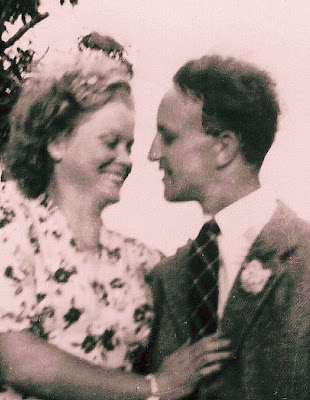
When Tony and Josie got married...
Mum with her own mother, my Scots-Irish Granny, and with her first baby; my sister.
With me when I was about eighteen years old. Please ignore floral jacket.
Mum in Paris with me and my sister, the year Princess Diana was killed there. Mum's in her favorite shade of red; my sister appears to be wearing a deceased animal with shoulder pads. I am honestly wearing a skirt, albeit a very short one, and black nail polish; Jesus, Mary and Joseph.
Mum went to Australia in her later years, when her health was already failing and she depended on a walking stick; she loved it there, later encouraging me to go and fall in love with the continent too.
My sister and I with Mum on her birthday, nine years ago.
This is one of the last photos taken of Mum, a few months before she died. It was taken on my birthday, almost exactly three years ago. Already very frail and ill here, she died little more than six months later.


"What would men be without women? Scarce, sir...mighty scarce." 
(Mark Twain)

"Que Sera Sera"  Doris Day


"Taking joy in living is a woman’s best cosmetic." 
(Rosalind Russell) 

"You educate a man; you educate a man. You educate a woman; you educate a generation." 
(Brigham Young) 

"I am a woman; my country is the whole world." 
(Virginia Woolf) 

Wednesday, 6 March 2013

Wherever


"You yourself, as much as anybody in the entire universe, deserve your love and affection." 
(Buddha)

The other day, I popped into church to light a candle for a friend. I exited onto the street, a short distance away from another woman who I know only to nod to. A man walking past turned to look at us and the church behind us. "Catholics!" he snorted, "You don't know whether you're coming or going these days!" I assumed this outburst was fueled by the current focus on alleged Cardinal sins. Sometimes, you come up with the perfect subtle yet incisive riposte, but it's hours or days after a challenging remark or put-down In this instance, my mouth just yapped out the first thing that came into my head: "No, but we're still here!" The other woman, probably in her late sixties, wearing very sensible shoes and carrying a possibly even more sensible bag of shopping from M and S, suddenly let out a raucous "Yeah, deal with it!" After this display of random but surprisingly satisfying unity, the man scarpered up the road; the woman and I set off in different directions.
Recently, there have been several seemingly authoritative reports concluding that the Catholic Church will now need to reflect on her way forward, particularly as she chooses and embraces a new pontiff. In fact, the Church will always need to reflect; she's the Church, for goodness sake. Of course, the Papal Conclave may well instigate more particular and specific dialogues, to be welcomed by many of us. Essentially, much as others might want her to disappear in a cloud of non-Vatican smoke, the Church isn't "going" anywhere in the most basic sense, but will continue to reach wherever we may be.
A lot of pointed and sometimes pointless commentaries will be made about the latest scandal in the Catholic Church in coming weeks, in and outside of the media. This post is sincerely not intended to join in such speculation. I'm not belittling the seriousness of any individual's situation, nor any future implications for the Church as a whole. But to paraphrase an old saying, faith and people can be a bit like teabags: you may not appreciate their strength until they're in hot water. The Catholic Church does expect a lot from people; in turn, we ask much more of her priests and effectively heaven and earth from the Church herself.

I do feel that although religion is sculpted and organised by man, faith is naturally occurring. I know that I'm still very ignorant about Catholicism, but my own rather unpolished faith feels instinctive. The truest friendships seem intuitive to me; it's instinctive for me to light a candle sometimes when I sense someone is feeling lost or dark. This is what I was doing the other day; this post is also partly for that friend, even if they never read it.
Unusually for me, I have no idea where I copied this prayer from, nor who originally composed it: it was nesting in one of my scribble-books. I've resisted the urge to Google it; also rather unusual for me. It's occurred to me that it doesn't matter where or who a wish, blessing, prayer or indeed faith comes from, simply where it's intended and who it might touch along the way.

*Prayer For Unfailing Strength* 
Do not look forward to what may happen 
tomorrow; the same everlasting One who cares 
for you today will take care of you tomorrow and 
every day. Either He will shield you from suffering, 
or He will give you unfailing strength to bear it. 
Be at peace, then. Put aside all anxious thoughts and 
imaginations, and say: "You are my 
strength and my shield. My heart has trusted in You 
and I am helped. You are not only with me but in me, 
and I in You." 

"Wherever You Will Go" Charlene Soraia

"No man who is occupied in doing a very difficult thing, and doing it very well, ever loses his self-respect." 
(George Bernard Shaw)

(Photo: Gigi, album)


Partners in the dance

"It sometimes takes a state of solitude to bring to mind the real power of companionship." 
(Stephen Richards)

Maurice with Evelyn

This Wednesday morning sees the funeral of my brother-in-law's stepfather. Maurice survived on his own for only six months after the death of his beloved Evelyn, Gordon's mother. I tried to gently warn Gordon this might well happen: sadly, I've seen this too many times when one half of a close and longstanding partnership dies. Maurice took to his bed at Christmas, his first in around forty years without Evelyn. Always a capable and proud Yorkshireman, strong in mind and body, he seemed to be broken somehow.
Admitted to hospital in February, he'd made it known that he didn't want to be fed, would not want to be resuscitated; didn't really care to go on. Maurice had survived Dunkirk and the trials of World War II in North Africa; his first wife had given up waiting for him to return from war and literally found someone else. Maurice married again and had two children with his second wife; when she became ill with cancer, he nursed her through her final months.
A hard-working weaving over-locker in the Yorkshire mill industry, he met former mill-girl Evelyn after the death of Gordon's father, Harry. Maurice and Evelyn had a courtship of tea-dances and a dancing partnership that continued into their eighties, when time began to slow their steps. My own humble experience of ballet and other dance has confirmed to me that the harmony and companionship of dance partners requires chemistry, understanding, respect, commitment and practice - rather like marriage, I would guess. Maurice was a devoted husband; Evelyn relied on his presence when they were both largely housebound during the past few years.
My brother-in-law pronounces himself an unequivocal atheist but has found some comfort that his mum and stepfather, as well as his dad, are all now resting in "eternal sleep". I have thought to myself that this is more than I've ever heard from other self-professed atheists; and actually very close to the sentiments of the Catholic "Requiem Eternam". Even though he's recently retired himself, I understand that Gordon is gazing into the void that inevitably gapes when your parents or step-parents pass: I know from experience that you're never too old to feel orphaned. I hope he and Maurice's son and daughter will take comfort that both Evelyn and Maurice were blessed to find devoted companionship not once but twice in their lives. I hope I've planted a tiny grain in Gordon's mind that his mum is to be reunited with the two great loves of her life. Her dance-card is complete.
"Eternal rest grant unto them Oh Lord
and let perpetual light shine upon them.
May they rest in peace,
Amen."

"When the years have done irreparable harm,
I can see us walking slowly arm in arm,
Just like that couple on the corner do:
Girl, I will always be in love with you.
Then when I leave this Earth
I'll be with the angels standin';
I'll be out there waiting for my true companion,
Just for my true companion."
(From "True Companion", Marc Cohn)

"Gallant Hussar" Eliza Carthy