Showing posts with label Celtic. Show all posts

Wednesday, 1 May 2013

The workers' saint


"St Joseph was a just man, a tireless worker, the upright guardian of those entrusted to his care. May he always guard, protect and enlighten families."
(Pope John Paul II)

The celebration of the first day of May has ancient origins. There's an obvious relationship with the Celtic pagan festival of Beltane and also with the Germanic celebration of Walpurgis Night. Although I'm sill unsure how or why the humble St Walpurga, an English missionary who helped to convert pagan Germany in the eighth century, has lent her name to a witches' sabbath. As the western world became Christianised, many popular secular holidays merged with Christian feasts. Through the 20th and 21st centuries, neo-pagans have resurrected and restructured many of the old traditions, including May Day festivities. 
As a secular celebration, "May Day" may be best known for maypole dancing and the crowning of the May queen. In pre-Christian Europe, the first day of May was also seen to be the first day of summer, in relation to the midsummer solstice in the second half of June. The Romans celebrated the feast of the goddess Flora at this time, the aptly named queen of flowers and plants. The Roman Catholic Church observes May as the month of the Virgin Mary; with statues of Mary often being adorned with crowns and wreaths of flowers.
May Day has had a tradition of community based festivities across the British Isles down the centuries. Towns and villages celebrated the fertility of the soil and the livestock. Seeding and sowing had usually been completed by this time of year and it would be convenient to allow farm workers and labourers a holiday. For some, May Day gained infamous "communist" associations. As the Catholic calendar was reformed, Pope Pius XII instituted the feast of St Joseph The Worker in 1955. Yet the the saint's patronage of workers and grafters has an older history.
Everything we know about Joseph originates from scripture. We know he was a working man and of limited means. Yet the gospels highlight his lineage from David, the king of Israel. I have a fondness for Joseph because he was very much an ordinary Joe, yet he displayed immense compassion and faith when he realised that his young bride to-be was already with child; supernaturally conceived at that. He initially considered ending their betrothal but feared for Mary's safety if she was shamed as an adulteress.
Clearly, Joseph loved Mary and would also love Jesus as his own, leaving his home and family to protect the child. The gospels note that the people of Nazareth referred to the boy Jesus as "the son of Joseph" without other distinction. Fittingly, Joseph is the patron saint of fathers; also of the Universal Church, of the dying, of social justice, and of course of carpenters.
The Christian Church has always been proud to emphasise Jesus' background as the step-son of a carpenter, probably apprenticed by Joseph himself. The humanity and humility of Jesus through Joseph's guardianship are evident; also the fulfillment and often sheer drudgery that can be part of vocation. Like his father on earth and in heaven, Jesus was a creator. I've always found it poignant that the carpenter's boy would ultimately bear his own wooden cross to be nailed to the Roman tree of execution.
I'm no carpenter, but I've loved working with discarded bits of wood or cut-offs to distress and tart up into driftwood-style shelves, frames and bits and pieces. I'm most fond of my "carpenter's crucifix". I think folk thought I'd finally lost it when I said I wanted to make the corpus out of nails and upholstery tacks, with a crown made of picture wire. A couple of years ago, if anyone had told me I would be thinking of making a crucifix at all, I'd have thought they'd gone large on the altar wine. But it seems to suit the little house; fashioned more from love than skill, as many precious things are.

(Photo: Gigi, album)

Located a well judged stone's throw away from me is the tall, Gothic Catholic church of St Joseph, at the foot of Elm Grove and just off the Lewes Road. Both roads have long been densely populated: they're areas frequented by locals rather than tourists. In the heart of uni-campus land, much of the Victorian housing is rented out. 
In the 1860s, a Mission Chapel stood on the site now occupied by St Joseph's. The current church is a Grade II listed building. However, due to outstanding debts, the church wasn't dedicated until 8th May 1979; a few days after the feast of St Joseph the Worker and a hundred years to the day since building work began.
The Lewes Road and surrounding areas are necessarily entrepreneurial and hand-to-mouth communities. Home to the local branch of The Society of St Vincent de Paul, the church is just a short wander away from one of the SVP's charity shops; traditionally sited in deprived areas. The Brighton shop is as well used as it is well stocked. St Joseph's today serves an increasingly multi-cultural congregation of local workers; those with jobs and those without.


www.stjosephsbrighton.co.uk

"If I Had a Hammer" The Seekers (version)

"In Joseph, faith is not separated from action."
(Pope Benedict XVI)

Sunday, 17 March 2013

The light heart or a dark pint: Happy St Patrick's Day

"The light heart lives long."
(Irish proverb)

Photo:St Patrick, patron saint of Ireland: arranged by 6th (Patcham) Westdene Guides
St Patrick's Day altar, 2012: All Saints Anglican Church in Patcham, East Sussex.

"The Fiddler's Elbow" in Brighton is ostensibly a decent, die-hard Irish boozer: every year, a local St Patrick's Day parade starts and returns there, and it generally hosts a weekend of Irish music and revelry. Having caught this year's flier (see below), I was quite intent on a Saturday evening of traditional Celtic high-jinks and the odd version of "Fields of Athenry" to sob into my glass of Virgin Mary to.
Having coerced a long suffering friend to go with me, we found that the pub's street party was two heaving beer tents outside the already rammed pub, with the "musical" element being drum and bass music belting out at eardrum-perforation level from a third tent. Apart from the Guinness and the ubiquitous lime-green party top-hats, Dublin and Belfast might just as well have been distant planets. I appreciate it was Saturday night and that this is very much a university town, but I can't be the only Brighton resident who expected to find the town that usually likes to enjoy itself a little too much most weekends a-wearing of the green and a-pogoing with The Pogues on this one weekend of the year?
I can't blame the pub: apparently they did have traditional Irish music playing on Friday evening, and they are patrons to Irish musicians across the year. It's a nice pub. Management were simply catering to your average Saturday night drinking crowd; just as the opposition were doing.


In 1800 there were some forty one inns and taverns in Brighton, equivalent to one inn for every thirty houses. They served the local fishing community upon which the town was founded, newly settled residents and the wealthy visitors and trippers who'd taking a shine to the original English seaside resort. By 2011, there were around fifteen hundred bars and pubs in Brighton and Hove. According to a citywide poll last year, more than sixty percent of the population feel that alcohol has to feature in social activities for them to enjoy themselves. Given Brighton's dark, longstanding reputation for substance abuse, I fond this sad as well as damning.
 I count myself incredibly fortunate that I've never felt I couldn't be merry or relaxed without a glass of something stronger than tea. I actually love the taste of a good white wine, a nice dry sherry or a sweet Tennessee whiskey, but my life isn't empty without it and I wouldn't even estimate that I have a "drink" once a week. I think I've only ever been drunk once in my life; I really didn't like it, or the sickness and fatigue that followed. When I was a bit younger, I could probably drink most of my friends, male and female, under the table and still get up and walk home,  probably giving bi-lingual, accurate directions to tourists on the way. I've always said that after one too many for me, I go into my Kylie routine, suddenly remembering all lyrics and dance routines; two drinks too many would see me harmonising with myself as both Annifrid and Agnetha from Abba. Beyond that, I would just feel sick. And stop.
I see females out and about in Brighton of all shapes, sizes and sensibilities with the skimpiest clothing and the most staggering heels, all still trying to strike a pose, after many bevvies past my Kylie stage. Usually, they're struggling to look sultry whilst sat in the gutter or lying on the pavement. I've sometimes stopped to ask if they're OK as various lads have been circling around them like vultures, only to be shrieked at to **** off and leave them alone to "enjoy" themselves. Of course, just as frequently and possibly almost as vulnerable, I do see lads of all ages from fourteen to four score and ten, crying, puking, urinating or bleeding in the street. Those who've "enjoyed" themselves to the max would seem to be those doing all of the above simultaneously.
If I sound harsh, I'm not without empathy. My own family hasn't been a stranger to addiction: my mother's only brother literally drank his life away and two of her sisters died of alcohol and tobacco related cancers; my father's gentle and kind-hearted nephew, my cousin, died of  heart failure at thirty years of age after drowning his sorrows a little too deeply a little too often. I know that for every person who drinks to remembrance, many drink to forget.
I've often perceived that the romantic but fiery Celtic psyche might lend itself more readily to that dream-catcher-turned-demon-drink. Walking home last night, I didn't see any drunk Irishmen (or women) on St Patrick's own evening. I merely waded through swaggers of smashed students and London day trippers, tripping over their green top-hats and asking what day it was. 
Today, I lamented the lack of St Pat's shindiggery in Brighton this year with an Irish pensioner who frequents my local Sainsbury's for the warmth of the air-conditioning as well as that of the regulars and staff. He told me it was a pitiful St Patrick's when there was no room in any bar for a decent Irishman to fall down. I said I'd missed hearing dozens of versions of "The Irish Rover" and felt cheated out of even one sobbed refrain of "Danny Boy". His reply made me crack a smile: "We have these songs in our hearts. If you know them, you will know them all year round and forever." See, this is why I love the Irishness.
I do feel my St Patrick's weekend was hijacked this year by those wanting to get legless rather than jig, to get wasted en-mass rather than toast a feeling of heritage or togetherness. Ah well. I already have my newly acquired little ukulele and am looking to get my very own Irish drum, a bodrhan, as a belated birthday gift. Next year, I may be inviting selected friends to join me in my parlour for St Pat's tea, tatties and proper Irish drum and bass.
Wherever you've been this St Patrick's Day, whatever you've done and whoever you've done it with I hope it went well and safely and you've the shoes, the shillings and the smile to get you to Easter. 
Slainte.

"May the saddest day of your future be no worse 
Than the happiest day of your past."


"In Ireland the inevitable never happens and the unexpected constantly occurs. "
(John Pentland Mahaffy)


"You Couldn't Have Come At A Better Time"  Luka Bloom

"You've got to do your own growing, no matter how tall your grandfather was."


"Raglan Road" Van Morison and The Chieftains

"God is good, but never dance in a small boat."


"The Fields of Athenry", wonderfully raucous version by The Dropkick Murphys

"Get on your knees and thank God for your two feet."


St Patrick's Trust

One place definitely open for business as expected, both yesterday and today, was St Patrick's Anglican Church in Hove. Still very much in use as a place of worship, St Pat's has been used as a night shelter for homeless people and addicts since 1985., when the parish priest allowed two rough sleepers to sleep on the floor of the church. More and more homeless people were encouraged to come forward and now over 300,000 bed spaces have been taken up over the years.
In 1987 a dedicated shelter was formed to raise funds as the church space was converted. St Patrick's Trust now offers help and support through the Night Shelter House and also the semi-independent organisation "Move-On Housing". As well as accommodation, the shelter is open from morning till night to offer advice, meals and social activities. The church continues to celebrate daily services.
Yesterday, St Pat's was offering tea, coffee and cakes and helpful literature to all-comers.


StPats-Hove.co.uk


Saturday, 9 February 2013

"I am the meaning of the poem"

"Nature is the direct expression of the divine imagination."
(John O'Donohue)


“I believe in the sun when it’s not shining, 
I believe in love when I feel it not, 
I believe in God even when he is silent.”
(Celtic proverb)

One fine thing about being confined to the house and not being able to work is that you get to read and listen to old loves that you keep meaning to sit down with again when you've got the shopping, painted the garden pots, touched up the varnish on the front door, sorted your life out.
I've been thinking a lot about the elements over the past few days: it's not difficult to see why man was in awe of the seasons long before flood barriers, the meteorological office or even sunblock were invented. The indigenous populations of the ancient world tended towards animist beliefs, imbuing any living creatures, objects and natural forces with "anima": soul or spirit. Animism is not a religion as such, but is certainly one of the oldest belief systems in the world; essentially, it's a way of viewing all of nature.
Today, many anthropologists studying religion have asserted that "modern" faiths are in continuity with the "magical thinking" of even our most primitive ancestors. Animism certainly assumes a relationship between the seen and the unseen worlds; an interaction between the human and the divine. Sometimes I feel education dulls the Christian perception of the spiritual within the everyday: surely the natural world enfolds the supernatural power and wonder of creation.
The late Irish poet and former Catholic priest, John O'Donohue, wrote extensively and beautifully about exploring the hidden universe that we all carry within, reflected in what we create in the outside world. He fully accepted that to be natural can be holy, that we're today's custodians of ancient, sacred thresholds.
His writing is seamlessly embroidered with ancient Celtic wisdom and lyricism. Not quite as comfortably, more than a millennium ago, the pagan lore and ritual of the Celts would become encompassed by the fervour and contemplation of early Christian mysticism. Significantly, the striking beauty of the traditional Celtic cross is said to have been introduced by St Patrick during his mission to convert the "pagan" Irish. Delivering the gospel to sun-worshipers, he combined Christ's cross with the circle as the sun: many also see it as a halo effect.
When Mum died, I was determined that her headstone should be a Celtic cross: her faith was that of her Scottish mother and her Irish father; only basically schooled, it was instinctive for her to believe in a higher power and a greater good. And to shamelessly ask St Anthony to find her the odd tenner that hadn't been lost yet.


Yesterday, I remembered that I'd copied down the poem "The Song of Amergin" in one of my scribble-books. Originally "Amhairghin", Gaelic for "birth of song", Amergin was a great poet and one of the legendary Celtic leaders who battled the Fairy Peoples for possession of Ireland. 
 "The Song of Amergin" invokes the power of the land itself but I feel it also unfolds the omnipotence of God at the heart of Christianity. Amergin may well have been "bigging himself up" by claiming the power of the elements; just as readily, he voices the strength and godliness that can be within each of us. The poem reminds me of "St Patrick's Breastplate"; it soothes as much as it empowers. 
Similarly, I found a list of CDs that I either haven't got round to buying or simply can't find on Amazon; "The Turning of the Tide" by Donegal-born singer Aoife is one of the latter. She sings in her native Irish with a real purity. Her version of an old Irish hymn, "My Love, My God", is one which I wanted to have played at my wedding, if such a day should ever dawn! Although the words are probably only a few centuries old, set to a much older melody, the hymn has the passion and sensuality of the Celtic Christian tradition. It's a lovesong to faith and also to God.


"The Song of Amergin"
(att. Amergin GlĂşingel) 
I am the wind on the sea, 
I am the ocean wave; 
I am the sound of the billows; 
I am the seven-horned stag; 
I am the hawk on the cliff; 
I am the dewdrop in sunlight; 
I am the fairest of flowers; 
I am the raging boar; 
I am the salmon in the deep pool; 
I am the lake on the plain; 
I am the meaning of the poem; 
I am the point of the spear; 
I am the God that makes fire in the head: 
Who levels the mountain? 
Who speaks the age of the moon? 
Who has been where the sun sleeps? 
Who, if not I? 

"Mo Ghrá'sa, Mo Dhia (My Love, My God)" Aoife Ní Fhearraigh


"Mo ghrá-sa, mo Dhia, mo ghárda, mo liaigh" 
(My love, my God, my guardian, my saviour)


"The world rests in the night. Trees, mountains, fields, and faces are released from the prison of shape and the burden of exposure. Each thing creeps back into its own nature within the shelter of the dark. Darkness is the ancient womb." 
(John O'Donohue)


"May the nourishment of the earth be yours, 
may the clarity of light be yours, 
may the fluency of the ocean be yours, 
may the protection of the ancestors be yours." 
(John O'Donohue)

Sunday, 3 February 2013

Lights and signs


"Look at how a single candle can both defy and define the darkness." 
(Anne Frank) 

"How far that little candle throws his beams! So shines a good deed in a weary world." 
(William Shakespeare) 


Yesterday was the beautiful, melancholic Christian feast of Candlemas, recalling when Mary was purified and blessed after childbirth, so that she could return to the Temple and present her baby Jesus there for the first time. When Mary and Joseph arrived at the Temple, one of the elders, Simeon, held the baby up spoke of him as the Messiah, "the light". The obvious significance of the feast of candles is that Christ is forever the Light of the World. As well as the church candles being blessed at Candlemas, when I was at school, people brought their own candles to church for blessing; I'm not sure how often this happens these days. Sometimes we all need a little help re-igniting or nurturing that spark of hope or love, to keep it burning through all weathers.
Before the birth of Christ, the pagan Celtic festival of "Imbolc" was celebrated at this time. Imbolc began at sunset on 1st February, itself the celebration of the pagan goddess Brighid, which would eventually become the Christian feast of St Brigid. "Imbolc" translates as "in the belly", referring to a time of renewal and the promise of abundance from the earth goddess. Imbolc marked the halfway point between the darkness of the Winter Solstice in December and the new light of the Spring Equinox in March. Fire played a huge part in the pagan festival; as well as being purifying, it signified the increasing power of the sun as the days lengthened. Christians began celebrating Candlemas as early as the fourth century. It's a bittersweet celebration; looking back to the recent joy and gift wrapping of Christmas, drawing breath before the penitential self denial of Lent. 


According to folklore, around Candlemas, snowdrops,"Winter's Bells", start blooming and the badger emerges, both heralding the beginning of the end of the cold weather. Sometimes frowned upon by the part of me that's trying to be a proper Catholic, the Irish in me is delighted by "signs". The first snowdrops in my garden are already pushing through the stones and slushy aftermath of winter. I told a friend a couple of days ago that I'd seen a badger snuffling around the undeveloped land at the back of my house; I thought I saw one late last year as well. He wasn't convinced, but yesterday I learned from one of our very own local elders that we have a large, established badger colony in Brighton. I live very close to a convergence of cemeteries and burial grounds: the old boy confirmed that these gruff critters grunt around the grounds at night, probably fueling Brighton's many urban ghost stories. (Personally, inspite of my proximity to the cemeteries, I would be more worried that anything shuffling about in the dark behind my house was an inept burglar: I don't believe the dead can hurt you, much as the living might try). A little digging on t'internet when I got home unearthed (sorry) a short film that Alan Titchmarsh made a couple of years ago, describing Brighton's badgers as "some of the city's oldest inhabitants". I have a feeling that my badger will turn his snout up at my veggie curries and felafel balls, but I'll be watching out for him.
Whether we admit to being superstitious or not, I'd hazard that we all look for signs from time to time: signs that we're doing the right thing, going the right way; signs that we're loved, that our lives have any meaning. Some signs are far more subtle than the obvious neon, flashing or dayglo varieties. I believe we each have our own light to shine; often an illuminating sign to ourselves and others, frequently taken for granted. When you watch children at play, no scenario seems impossible to them; they sparkle because they can and because nobody has yet told them they shouldn't. When we allow our own light to show, we unconsciously give that sign to others to do the same. Not all of us are electrifying: some of us are more like twinkling candles, but one tea-light can set dozens of candelabras blazing. Obviously, I believe that spark is God-given. We should never let anyone try to extinguish our own light: sometimes we feel relegated to the shadows, but the smallest glimmer can guide or define us in the gloom.
During the past week, we've had severe problems with electrical power in my street.: there are now two large holes on opposite sides of a very small road and a very noisy mobile generator appeared to be running the show until Friday. I'm a real sucker for candlelight and have sconces and tea-lights a go-go. I'm largely unphased by the lights going out, although less keen on the prospect of stone cold water and an uncharged laptop. To be honest, part of me (probably that Irish bit again) is a little disappointed that the street wasn't a flickering little settlement of candlelit windows this Candlemas. I decided to refrain from hitting the light switch yesterday afternoon to watch the opening matches of the Six Nations Rugby. Anyone glancing through my front window would've caught me cussing at the referee by candlelight, with the added incentive of the heady scent of ginger and sandalwood. We take electricity for granted on a daily basis, until we're forced to rely on a more basic source of power again and rediscover our childhood wonder for the flame.
"We can easily forgive a child who is afraid of the dark; the real tragedy of life is when men are afraid of the light."
(Plato)

"Thousands of candles can be lighted from a single candle, and the life of the candle will not be shortened. Happiness never decreases by being shared."
(Buddhist proverb)


"Simple Gifts"  Alison Krauss (with cellist Yo-yo Ma)

Sunday, 27 January 2013

Australia, for everyday and always


"We are all visitors to this time, this place. We are just passing through. Our purpose here is to observe, to learn, to grow, to love; and then we return home."
(Proverb of the Indigenous people of Northern Territory, Australia)

I was in two minds (happens a lot) about writing a post for Australia Day, but I eventually succumbed to my longstanding love for The Lucky Country and a couple of cyber-nudges from two greatly missed Aussie friends. "Australia Day", 26th January, is a national holiday in Australia and the focus for sentimental and enthusiastic celebration for Australians abroad. 
Previously known as "Foundation Day", the holiday marks the landing of the First Fleet: the eleven ships of the British Admiralty, sent to establish a penal colony at the place that would become Botany Bay, New South Wales. Captain James Cook had explored and "claimed" the land some seventeen years earlier, and the Dutch had clocked it a hundred years before him. But it was Captain Arthur Phillip who, after some forays into the surrounding areas, "took possession" of the land around a geographically welcoming cove in the name of King George III on 26th January, 1787. Phillip named their colony after the then Home Secretary, Thomas Townsend - Viscount Sydney.
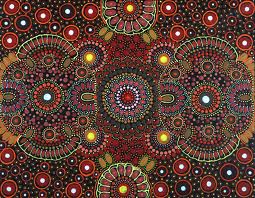
The name "Terra Australis Incognita", Latin for "Unknown Southern Land", dates back to the Roman empire, and legends of the mysterious continent evolved with medieval geography. Yet human habitation of the land began about 50,000 years ago. The ancestors of today's indigenous Australians were among the most ancient peoples of the earth, and the vast land was home to at least two hundred and fifty tribes, with their own languages. When the Europeans invaded, which is what we did, the Aborigines were hunter-gatherer peoples, with complex, oral-based cultures and a tradition of story-telling and celebration. Spiritual values were strong and binding to the land itself; there was a reverence for nature. "The Dreamtime" encompasses not only the story of the creator spirit and creation itself but also births the animist beliefs that have survived tens of thousands of years. 

The stories of The Dreamtime shaped Aborigine laws and customs, incorporating art and dancing. The emphasis was on belonging to and showing respect for the land that nurtured them; Australian soil is known to be the oldest on the planet, and the driest. Yet it remains a painful fact that the Federal Government of Australia would not recognise Aboriginal title, the traditional ownership of any land, until 1992.
National research in 2009 confirmed that ninety percent of all Australians polled felt it was  important to recognise and include the indigenous culture as part of the Australia Day festivities; however, the commemorative date of the celebration is still divisive. Although many indigenous Australians celebrate Australia Day, "Invasion Day" protests occur almost every year. Moves to change the holiday to another date may well cause further rifts in the population, at a time when the emphasis is on recognition and reconciliation.
I love Australia: I've been fortunate enough to visit the Lucky Country five times in the past twenty years, although not since 2008. From day one, I felt almost seduced by the country; I long to go back and familiar sights on various antipodean based relocation series find me sniffling in front of the telly. It helps that I'm uncommonly fond of large spiders, snakes and reptiles, but the colour and vibrancy of the country seem to draw energies out of my usually quite shy personality. In Australia, I'm able to indulge my penchant for trees, rocks and soil without feeling at all unfeminine. I get to climb up things, simply because they're there. I can wear as many colours as I want, how I want, with bangles up to my armpits. Every second person you meet really does have an Irish grandmother. In fact, the blend of immigrant cultures has borne it's own aspirational kinship. Some of the good friends I've known from Australia have been from very mixed race backgrounds and others have extended families that include indigenous Australians. The Celtic heritage is instantly reassuring, but I've always been fascinated that it sits so deep and easy with the art and stories of The Dreamtime, which are simultaneously unsophisticated and intricate. 

The relevance of the landscape and it's supported nature is unashamed, even when Australia boasts the twelfth largest economy in the world. The presence of nature and evolution itself is palpable, even in the cities. In a country that now paints itself as not particularly religious, the bedrock itself seems invested with spirit and wants to sing about it. The last time I visited, I made it to the red, dusty centre: Alice Springs and Uluru were National Geographic-pretty but the ancient power of the landscape was breath-taking. The photos at the bottom of this post are mine; I was able to wait before dawn to see the rocks of Uluru change colour as the sun rose. I found it profoundly spiritual to witness new daybreak, almost at the dateline, in such prehistoric terrain.
So I have mixed feelings about celebrating Australia Day, but I have no qualms abut celebrating Australia, as a country and as a people. I've written this post with an affection and empathy that I hope is obvious: there's no intention to offend anyone who calls Australia home.
I've included two blessings here that have evolved from the optimistic indigenous Christian movement in Australia. The country has no state religion, but the Catholic Church has benefited from post-war multi-cultural immigration and now has the largest affiliation. The Catholic education system is still the largest non-government educator; similarly, Catholic Health Australia is the largest non-government healthcare provider. However, as social journalist Caroline Jones noted: "Aboriginal people are a steady beating heart at the centre of Australian spiritual identity."
I'm mindful of the almost biblical battering the elements have unleashed on Australia recently: some of my friends have been sweltering and living in fear of wildfires; others were dealing with torrential downpours and the threat of tornadoes on this 26th January. My thoughts are with them. God bless Australia, everyday.


"A Prayer for Reconciliation"
Father of all,
You gave us the Dreaming:
You have spoken to us through our beliefs.
You then made Your love clear to us in the gift of Your Son.
We thank You for Your care:
You own us,
You are our hope.
Make us strong as we face the problems of change.
We ask You to help all the peoples of Australia to listen to each other and respect our cultures.
Make the knowledge of You grow strong in all people,
So that You can be at home in us and we can make a home for everyone in our land.


"A Blessing" 
To all who walk this land, 
May you always stand as tall as a tree, 
Be as gentle as the morning mist,
As strong as the earth under your feet. 
May the warmth of the campfire be in you;
And may the Creator Spirit of the Southern people always watch over you. 


(All photos: Gigi, album)

"This is the land of dreamings, a land of wide horizons and secret places. The first people, our ancestors, created this country in the culture that binds us to it." 
(Hetti Perkins)

"Keep your eyes on the sun and you'll not see the shadows." 
(Indigenous Australian proverb)


"The Holy Grail"  Hunters and Collectors


Sunday, 14 October 2012

The things my mother told me...


"May the nourishment of the earth be yours,
May the clarity of light be yours,
May the fluency of the ocean be yours,
May the protection of the ancestors be yours.
And so may a slow 
Wind work these words 
Of love around you, 
An invisible cloak 
To mind your life."
(From "Beannacht - For Josie", by John O'Donohue)


Josie Kelly: Gigi, family album

The late, lovely poet John O'Donohue wrote "Beannacht", which is Gaelic for "Blessing", for his own mother Josie during her lifetime. When I was putting together a wake for my Mum, Josie Kelly, I had a friend read the poem out in it's entirety; although the words reproduced above have always touched me most deeply. My Mum and Dad are now the invisible cloak that minds my life.
This Wednesday marked the second anniversary of my mother's death: she died on the morning of  10.10.2010. Although time appears to have flown by, I still seem to be slow at navigating the yawning void that has opened up in the very middle of my life. Until I moved to Brighton, I saw Mum everyday; once I had moved, I spoke to her everyday. I realise that losing my job around the same time that I lost my mother could only ever isolate me further: living on my own, I also find myself yearning for the camaraderie of my old colleagues. But more than anything, I can't deny that I miss my mum. 
Mum was one of a family of six children: the eldest was a step-sister who would quickly emigrate to Australia, the youngest was her only brother William; Josie was the youngest of the four sisters in between. With varying shades of strawberry blonde hair and Irish blue eyes, they were feisty and pretty and were known as The Kelly Girls around Antrim and Derry. My Auntie Barbara told me that when they were growing up Mum was generally stubborn and often cantankerous but always cute. Her enchantment of my father is recounted elsewhere in this blog; for her part, Mum appeared to have countless suitors but maintained she had only loved once. Living in my father's native Belgium and then Switzerland and France during the first fifteen years of their marriage, she loved the French culture and language, but she learned to speak French her way, with an unshakable Northern Irish accent. Mum was eternally Irish. She would cheerfully say she was born in "the Black North", but being born just before the partitioning of the Irish counties, she refused to recognise the divide, with an indignity I uphold. Her Irishness seems to have been as infectious for my Dad: he surely had a greater knowledge of Irish political history and a more prolific collection of Irish folk and rebel songs than your average, conservatively raised Walloon. And so the Sundays of my childhood resonated with Gregorian chant, Edith Piaf, The Dubliners and various versions of "Kevin Barry" and "The Fields of Athenry".
Mum was always a bit of a conundrum. Just as she was a resolute vegetarian who didn't care for many vegetables, she was also a confirmed Catholic who believed in fairies, omens and ghosts. Superstition and ritual featured large in her Catholic upbringing. Her own beloved Scottish mother, who I never knew, was a devout woman who could apparently"see" the fate of others; the local parish priest often asked for advice and assured my granny that she was thus "gifted" because she was close to God. Mum would often mutter prayers in front of the red-lit picture of The Scared Heart (above the fridge), asking The Virgin Mary, St Rita or St Anthony to fix or find things, to keep people safe or show them the error of their ways.
When my Dad died suddenly and my big sister left to travel across the world with the man she would marry, I feel I formed an enviable bond with Mum. At times, certainly in later years, I admit that I could feel smothered and stuck. The memory of that resentment is painful for me now: sometimes contrarily argumentative and startlingly devoid of tact, Mum loved my sister and I unconditionally and fiercely. She could be generous to a fault: some folk could pop in for a cuppa and still be there through lunch and dinner, and maybe even a drop of whiskey to set them back en route. At other times, she might resolutely refuse to open the door to neighbours or friends if she was having a bad hair or even a "bad house" day. She could be endlessly kind but brutally honest, frequently advising other people's daughters in shop changing rooms that a skirt or dress made them look fat, thin, peaky or just plain dreadful!
She could appear judgemental, largely due to the narrowness of her geography and religion. Yet I remember her instinctive reaction when she came to visit a man I had been helping to care for, in his last, painful stages of AIDS. His condition and homosexuality had blinded his own Portuguese Catholic family; when Mum asked him where his mother was, he started to cry. Always phobic about hospitals and terrified by the media's HIV and AIDS fever, my own Mum held Paolo's hand and told him she would be his mother that afternoon. I've never forgotten that; it helps me remember how I came to be me.
She had an unspoken fearlessness about her, which must have been attractive to my just and outspoken father. Once settled in south London, she rarely felt the need to travel across the Thames; yet she traveled to Australia and the Far East with my sister when she was well into her seventies and dependent on a walking stick. When I was younger, she would sometimes come along to reggae and punk gigs; she could often be heard offering young men with towering Mohican hairdos cough sweets and tissues. She became a big fan of singer and gay rights activist Tom Robinson, who referred to her as "Mum" on more than one occasion.
When I was arranging Mum's wake, I wrote the poem "Josie Kelly", which tumbled out in a rush of recognition of all that's Mum that I now see in me. I wanted to share it here, along with some of the (very many) things she would often tell me. She shared some of my taste in music, if not the full diversity which I inherited from Dad. She never tired of traditional Celtic music, including the pipes and the marching bands of the Orangemen, but I managed to introduce her to the likes of Springsteen, Van Morrison, Kings of Leon, Eddi Reader, Brian Kennedy, Damien Rice... I literally introduced her to Norn Ireland's own Snow Patrol, which is a whole other story. She grew to be especially fond of the band; her favourite Snow Patrol song, which reminded her of The Troubles, is included here. Mum felt that frontman Gary Lightbody would have made a fine Catholic priest, which would certainly be news to his lovely Protestant family back in Bangor. Mum frequently asserted that various people would've made fine Catholic priests. Apart from Blessed Pope John Paul: she thought he was wonderful of course, but felt he would've made a great rock star.
And people wonder where I get it from.


Things My Mother Told Me
Never let the sun set on an argument.
Never take your health for granted.
What's meant for you will surely not go past you.
That her marriage to my Dad was made in Heaven; or at the very least, the wedding license was filed there.
That I would never have much money, but that needn't mean I would ever be poor.
Money puts a price on happiness but still can't buy it.
Always accept an apology. It makes it easier to offer one.
God does indeed move in mysterious ways: why wouldn't He; He's God?
Irish people know how to laugh at themselves, which has encouraged the English to make Irish jokes because they haven't yet learned to laugh at themselves.
If you believe you're right, stand up and fight for your opinion, until you're knocked down; then, sit down and carry on shouting.
Men who mock women for being virgins, or chaste or celibate, are not fit for love-making.
You should marry for love and work for money, not the other way round.
That her lack of culinary skills hadn't affected her raising a family: she simply married a man who loved cooking and had one daughter who loved the preparing and eating of food and another who liked to eat out.
You can wear tartan with floral, polka dots with stripes; as long as none of it is wearing you.
You can paint your face but not a smile on it.
Real class has nothing to do with where you are on any social scale.
That talking to my plants would help me as much as them.
Irish people are born to laugh and cry; sometimes, both at the same time.
That I should've married Bruce Springsteen.
Always keep a clean house: you don't want burglars thinking you're slovenly.
Always wear good underwear, in case you get knocked down or have to climb up something.
That I had her mother's gift of "knowing" things for others but would always be shortsighted about my own life.
Anyone with a semblance of decency surely has an Irish or Scottish grandmother tucked away somewhere.
Don't worry if people talk about you: at least you've been noticed.
That all the Christian denominations quite like the idea of being Catholic.
That I would grow more like her and my Dad as I grow older; that it would become my greatest comfort.
That she would die on a Sunday morning.
That I would miss her every day of my life.


"Josie Kelly"
Where have you gone Mum?
Not at the end of the 'phone,
nor waiting in my sister's car 
or scowling in the hated chair. 
My mirror reflects a pale ache of you, 
but you are there at the corners of my mouth, 
stretching my shy smile to a farm-girl grin. 
You are in the cussedness of my fringe, 
in my eagerness to laugh and in the easiness of my tears. 
You are in the rising of my temper and the dropping
of all wrongs before bedtime. 
You are in the tapping of my feet, 
from Springsteen to Sean South of Garryowen. 
You are in my green fingers, 
my need to nurture seeds and pips, twigs and stones. 
You are the way of grace in me, 
and in my knack for falling off kerbs while standing still 
and eyeing up a mountain. 
You are in my constant boiling of the kettle, my cake kept for strangers,
my sweeping of the stairs for critical burglars. 
You are in my lust for red shoes and handbags, 
in the miraculous medals in my purse; 
in my calling on the saints 
for lost rings, people and battles. 
You are in my recollections of an Ireland I never knew; 
you are in my love for my father and his faith,
and for your own mother's telling of the unknown. 
You are the gossamer that binds me and my sister 
beyond all differences of time, place or opinion.
You and my father are in my veins like whiskey and syrup: 
more than any DNA, 
you are at the core of me.
You are the skip in the heartbeat of all those who may come to love me; 
and you are in the echo of me, 
as I am in your footsteps. 
Where have you gone Mum? 
Wherever I am going. 
                                                                                                                                              Gigi


"The Fields of Athenry"  Brian Kennedy

"Open Your Eyes"  Snow Patrol